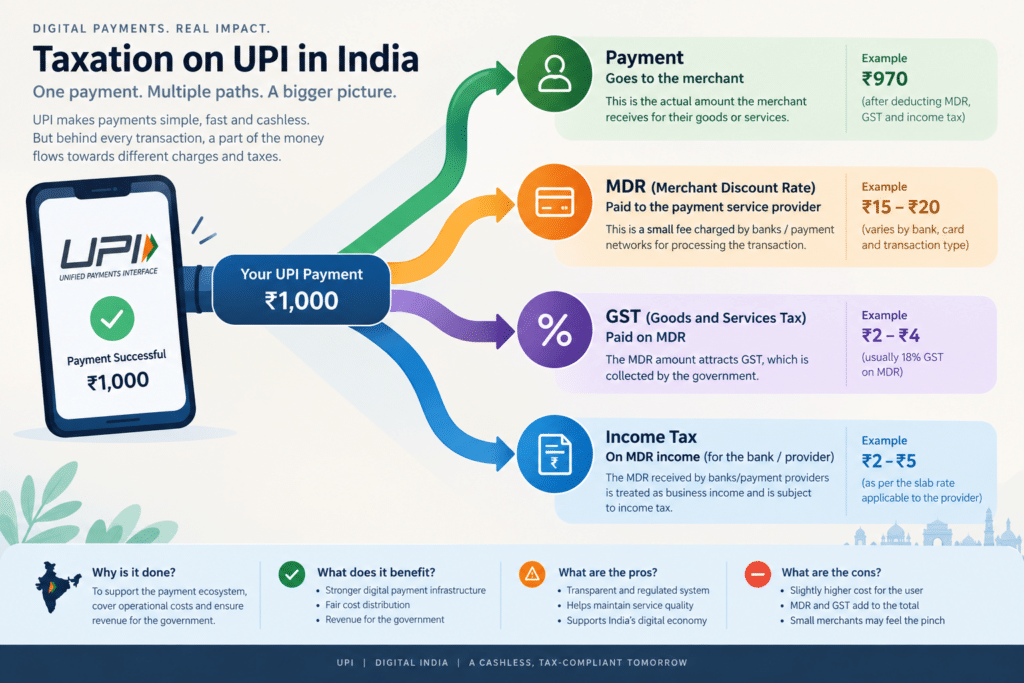
Taxation on UPI in India has become one of the most confused topics online, with headlines about a “₹2,000 UPI tax” spreading faster than the actual policy details. This guide breaks down exactly what changes from October 15, 2026, and what doesn’t.
Last Updated: September 23, 2026
Current verified position in short: There is no “UPI tax.” Person-to-person UPI transfers stay free at any amount. From October 15, 2026, a new Merchant Discount Rate (MDR) of 0.4% applies only to person-to-merchant UPI payments above ₹2,000, capped at ₹300 per transaction. GST at 18% applies to that MDR fee, not to the payment amount, and GST-registered merchants can claim it back as input tax credit. Small merchants receiving up to ₹1 lakh a month via UPI stay exempt. Consumers are not charged, and merchants are barred from passing the fee onto them.
In Simple Words
Before the detail, here is the short version:
- Sending money to friends or family on UPI, at any amount, stays free. This has not changed.
- Buying something from a shop for ₹2,000 or less on UPI stays free, no matter how many times you do it in a day.
- Buying something for more than ₹2,000 from most merchants means the merchant, not you, may now pay a small processing fee (0.4%, capped at ₹300).
- That fee is called MDR. It is not income tax, and it is not a tax on your payment.
- GST applies to that MDR fee (at 18%), not to the ₹2,000+ amount you paid.
- Using UPI to pay or receive money does not, by itself, make that money taxable income. What makes money taxable is what the money actually is salary, business income, a gift, a loan, and so on not which app moved it.
- Small shopkeepers and street vendors under the ₹1 lakh/month threshold are not affected at all.
- Businesses above that threshold should start tracking MDR and GST-on-MDR in their books from October 15, 2026.
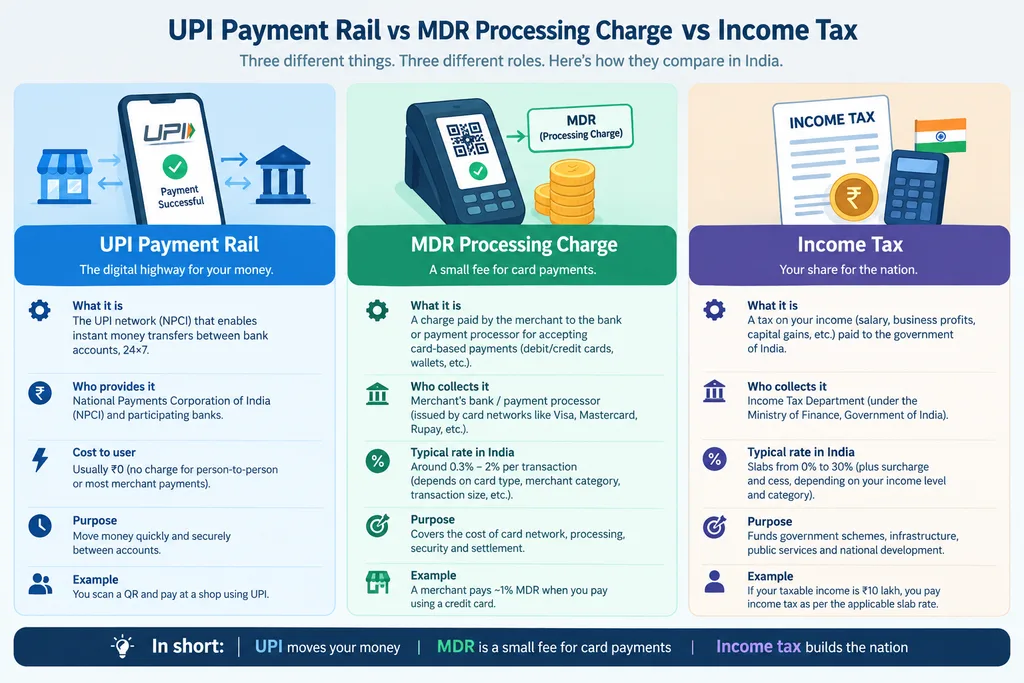
Keep this distinction in your head for the rest of the article: UPI is the payment rail. MDR is a processing fee some merchants now pay. GST here taxes that fee, not your money. Income tax depends on what the money is, never on the app you used to move it.
Taxation on UPI in India: Is There Really a Tax on UPI Payments?
Short answer: no, not in the way social media claims suggest.
There is no separate “UPI tax” in Indian law. What exists is a Merchant Discount Rate (MDR) a payment-processing charge that select merchants will start paying from October 15, 2026, on UPI payments above ₹2,000. GST applies to that processing fee, the way GST applies to most services, not to the underlying payment.
Whether money you receive is taxable income is a completely separate question that has nothing to do with UPI. It depends on the source of the money: salary, business receipts, a gift, a loan, a refund, and so on. UPI is just the pipe the money travelled through. The pipe does not decide the tax outcome.
This confusion has circulated online for a while. In April 2025, the Ministry of Finance publicly called out claims that GST would be charged on UPI transactions above ₹2,000, describing them as false and without basis, and pointed out that at the time there was no MDR on UPI at all, so there was nothing for GST to attach to. That statement is now the historical baseline. What changed since then is covered in the next section.
Quick answers to what people actually search for:
- Does sending ₹500 to a friend create a “UPI tax”? No. P2P transfers are not subject to MDR at any amount.
- Does receiving ₹10,000 from a friend create a tax? Not because of UPI. If it is genuinely a personal transfer (not disguised business income), UPI does not change its tax treatment.
- Does paying ₹5,000 to a shop mean you personally pay 0.4%? No. The merchant may owe MDR to their bank; you pay exactly the price shown.
- Does receiving money through UPI automatically make it taxable income? No. The nature of the receipt decides that, not the payment method.
- Is MDR a tax? No. It is a commercial payment-processing fee, similar to what merchants have always paid on card payments.
- Does GST apply to the ₹2,000+ amount or to the fee? To the fee (MDR), not the transaction amount.
- Who pays MDR? The merchant, deducted from their settlement by their acquiring bank.
- Can a merchant pass the MDR to the customer? No. NPCI’s framework explicitly bars merchants and UPI apps from charging consumers extra for UPI payments.
- What happens to small merchants? Those receiving up to ₹1 lakh a month via UPI QR codes stay outside the MDR framework entirely.
Also Read: Contract Jobs in India: Why They’re Replacing Permanent Roles in 2026
UPI Tax vs Income Tax vs GST vs MDR
This table exists because most of the online confusion comes from people using these five terms interchangeably. They are not the same thing.
UPI & Indian Taxes — What Actually Applies?
A quick-reference comparison of income tax, GST, TDS/TCS, MDR, and UPI fees — and whether using UPI itself triggers any of them.
| Concept | What triggers it? | Who is generally affected? | Is it a tax? | Does using UPI itself trigger it? |
|---|---|---|---|---|
| Income Tax | Earning taxable income (salary, business profit, capital gains, etc.) | Anyone earning above the exemption threshold | Yes | NoThe underlying income triggers it, not the payment method. |
| GST | Supply of goods or services, including payment-processing services like MDR | Businesses and service providers registered under GST | Yes | NoGST attaches to the MDR service fee, not the UPI payment itself. |
| TDS | Certain payments crossing specified thresholds (salary, contractor payments, rent, professional fees) | Payers who deduct tax before paying | YesA collection mechanism for income tax. | NoDetermined by the nature of the payment, not the app used. |
| TCS | Sale of specified goods or certain remittances/receipts above thresholds | Sellers/collectors in specified categories | YesA collection mechanism. | No |
| MDR (Merchant Discount Rate) | A P2M UPI payment above ₹2,000 to a non-exempt merchant, from Oct 15, 2026 | Merchants (not customers) | NoA processing/service charge. | YesThe one exception — a UPI/card-payment mechanism. |
| UPI app charges to customers | Not applicable — explicitly prohibited by NPCI | Nobody; consumers are protected | No | No |
| Government UPI incentive scheme | A subsidy paid by the government to banks/PSPs to keep small-value UPI free | Banks and payment service providers (indirectly benefits small merchants) | NoA subsidy — the reverse of a tax. | IndirectlyFunds the zero-MDR structure for small transactions. |
The one row worth re-reading: MDR is the only item on this list that UPI usage itself can trigger, and even then only for merchant payments above ₹2,000. Everything else on the list depends on the nature of the underlying money, not the payment app.
What Changed for UPI Payments in 2026?
Two different moments get conflated online: the April 2025 clarification and the September 2026 policy change. They are not the same event, and mixing them up is where most of the misinformation comes from.
UPI & MDR Timeline — 2020 to 2026
How UPI went from fully free (2020) to a targeted MDR return above ₹2,000 (October 2026) — and the rumor in between that never was.
| Period | UPI/MDR position | Who was affected | Key point |
|---|---|---|---|
| January 2020 onward | CBDT gazette notification (December 30, 2019) removed MDR on P2M UPI transactions entirely | Everyone — UPI became fully free for merchants | Made UPI free to drive adoption; funded partly through a government incentive scheme running since FY2021-22 |
| April 2025 | Finance Ministry publicly denied reports of a proposed GST on UPI transactions above ₹2,000, confirming no MDR existed at the time and therefore no GST could apply | General public exposed to viral claims | Rumor denied This was a denial of a rumor, not the introduction of a new policy — it describes the “before” state, not the current one |
| August 2026 (Monsoon Session) | Parliament passed statutory amendments enabling a revised MDR framework | Sets the legal basis for what follows | Enabling legislation Reported as the enabling legislation behind the October rollout |
| September 14–15, 2026 | Finance Ministry gazette notification followed by an NPCI circular finalizing the new MDR structure | Banks, payment service providers, merchants | This is the actual current policy: MDR returns, but narrowly — only above ₹2,000 for P2M payments |
| October 15, 2026 | New MDR framework goes live | Merchants processing P2M payments above ₹2,000 (excluding exempt categories) | In effect Effective date; consumers and P2P transfers unaffected |
The mistake to avoid: treating the 2025 “no GST on UPI” clarification as if it still describes 2026. It described a world where MDR did not exist. MDR now exists, narrowly, and GST attaches to that fee, not to your payment.
What Is Merchant Discount Rate (MDR)?
Think of UPI as the payment rail, the wire that moves money from your bank account to a merchant’s account instantly. MDR is not part of that rail. It is a processing fee charged for the acceptance infrastructure around a payment: the systems that authorize it, settle it, and protect it from fraud.
Every digital payment method has some version of this. Credit and debit cards have carried MDR for years. UPI did not, because the government waived it in 2020 specifically to accelerate adoption. That waiver was never described as permanent; it was a bridge to get UPI to scale.
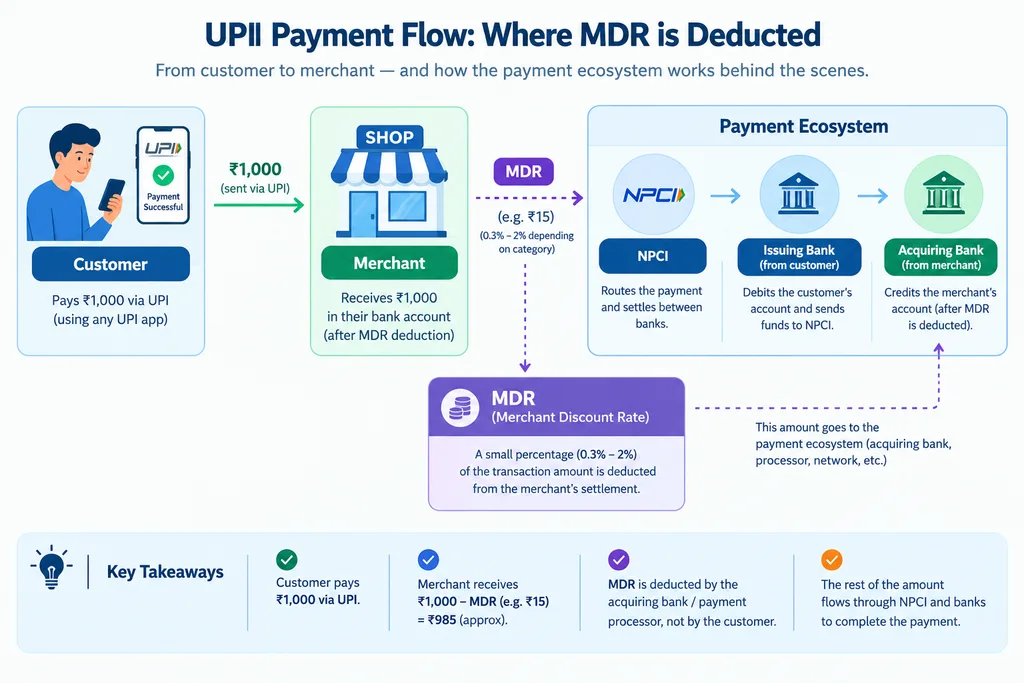
From October 15, 2026, here is how the new framework works for non-exempt P2M transactions:
- 0.4% MDR on P2M UPI payments above ₹2,000, deducted by the merchant’s acquiring bank from the settlement amount before the merchant receives it.
- Capped at ₹300 per transaction for payments of ₹75,000 or more, so the fee does not scale without limit on very large purchases.
- A flat ₹5 MDR (instead of the 0.4% rate) for specified categories such as railways, telecom, insurance, and fuel, on transactions above ₹2,000.
- Multiple industry reports describe the 40-basis-point fee as being shared across the ecosystem participants involved in processing the payment, including the customer’s bank, the merchant’s acquiring bank, and the UPI app or payment service provider.
- The exact percentage split reported varies by source, so treat any specific split you see (for example, “40% to the issuing bank”) as an industry-reported figure rather than an officially confirmed universal formula, since the actual allocation can depend on the specific banking and PSP arrangement behind a transaction.
Two things MDR is explicitly not:
- It is not paid by the customer. NPCI’s framework, and the Ministry of Finance’s public statements around it, are explicit that consumers making UPI payments will not be charged anything extra, and that merchants and UPI apps are barred from adding a surcharge for UPI payments.
- It is not a government tax. It is a commercial fee between the merchant and the banking/payments ecosystem that processes the transaction. GST is then charged on top of that fee, because GST applies to services, and payment processing is a service.
Also Read: Blockchain Technology: Why Countries Should Adopt It As Soon As Possible in 2026
Does the ₹2,000 Threshold Apply to Every UPI Transaction?
No, and this is the single most misunderstood part of the policy. Here is what the threshold actually does and does not do:
- It applies only to P2M (person-to-merchant) transactions, not to P2P transfers between individuals.
- It is evaluated per transaction, not as a running daily or monthly total. A ₹2,000 payment and a separate ₹2,000 payment on the same day are each below the threshold individually.
- Only the portion of the framework that determines whether MDR applies uses ₹2,000 as the cutoff. It does not determine whether income tax applies to anything.
- MDR is charged to the merchant, not deducted from the customer’s payment. If an item costs ₹2,500, you still pay exactly ₹2,500.
- Sector-specific exceptions exist. Railways, telecom, insurance, and fuel merchants pay a flat ₹5 instead of 0.4% once a transaction crosses ₹2,000.
- Small merchants are exempt regardless of individual transaction size, provided their total UPI receipts stay under ₹1 lakh a month.
- The threshold and rates were finalized in a September 2026 NPCI circular and could be revisited by NPCI or the government in future circulars, the same way UPI’s P2M daily transaction limits have been revised before. Nothing about this framework should be assumed permanent.
- One documented industry concern (reported by trade press in September 2026) is that because there is no daily cap on the number of sub-₹2,000 transactions, merchants or customers could in theory split a larger purchase into multiple smaller payments to stay under the threshold. This is a reported concern about the design of the rule, not a confirmed loophole with official guidance either encouraging or penalizing it.
Who Pays MDR, and Where Does the Money Go?
The merchant pays it. Specifically, the merchant’s acquiring bank deducts the MDR from the gross amount before settling funds into the merchant’s account.
If a customer pays a merchant ₹5,000, the merchant does not receive ₹5,000 minus nothing; the acquiring bank deducts the applicable MDR (₹20, at 0.4%) and the merchant’s payout reflects that.
The ecosystem participants typically involved in a UPI merchant payment include:
- The issuing bank (the customer’s bank, which holds the account the money leaves from)
- The acquiring bank (the merchant’s bank, which onboards the merchant to accept UPI payments)
- Payment service providers / TPAPs (the UPI apps and payment gateways facilitating the transaction)
- NPCI, which operates the UPI network itself and sets the operating rules
Multiple reports describe the 0.4% fee as being distributed among these participants, with the customer’s issuing bank generally reported to receive the largest share, followed by the acquiring bank and the UPI app or PSP.
Because these figures come from industry reporting rather than a single official, universally applicable schedule, treat any specific percentage breakdown as indicative of how the ecosystem has been described, not as a number you should build detailed financial projections on without checking the latest NPCI circular.
Does GST Apply to UPI or to MDR?
GST applies to MDR, the service fee, not to your ₹2,000+ purchase amount.
Here is a worked example on a ₹5,000 merchant payment:
- Transaction amount: ₹5,000
- MDR at 0.4%: ₹20
- GST at 18% on that ₹20 MDR: ₹3.60
- Merchant’s total processing cost: ₹23.60
- What the customer pays: ₹5,000 (unchanged)
- What the merchant is settled: ₹4,976.40 (₹5,000 minus MDR minus GST on MDR)
For GST-registered merchants, this is not necessarily a permanent cost. Tax professionals quoted in coverage of the policy note that a merchant with an output GST liability can claim input tax credit (ITC) on the GST paid on MDR and use it to offset GST owed on their own sales, which softens the real-world impact for registered businesses.
Merchants who are not GST-registered, or whose output liability doesn’t fully absorb the credit, feel more of the cost directly.
One tax expert’s estimate reported in coverage of the policy put the additional GST revenue this could generate for the government at roughly ₹3,500–4,000 crore annually.
That is an estimate from a named tax professional commenting on the policy, not an official government revenue projection, and should be presented as such.
How Much Would a UPI Merchant Payment Actually Cost? (Worked Examples)
All figures below are illustrative calculations based on the verified 0.4% MDR / 18% GST-on-MDR / ₹300 cap framework effective October 15, 2026.
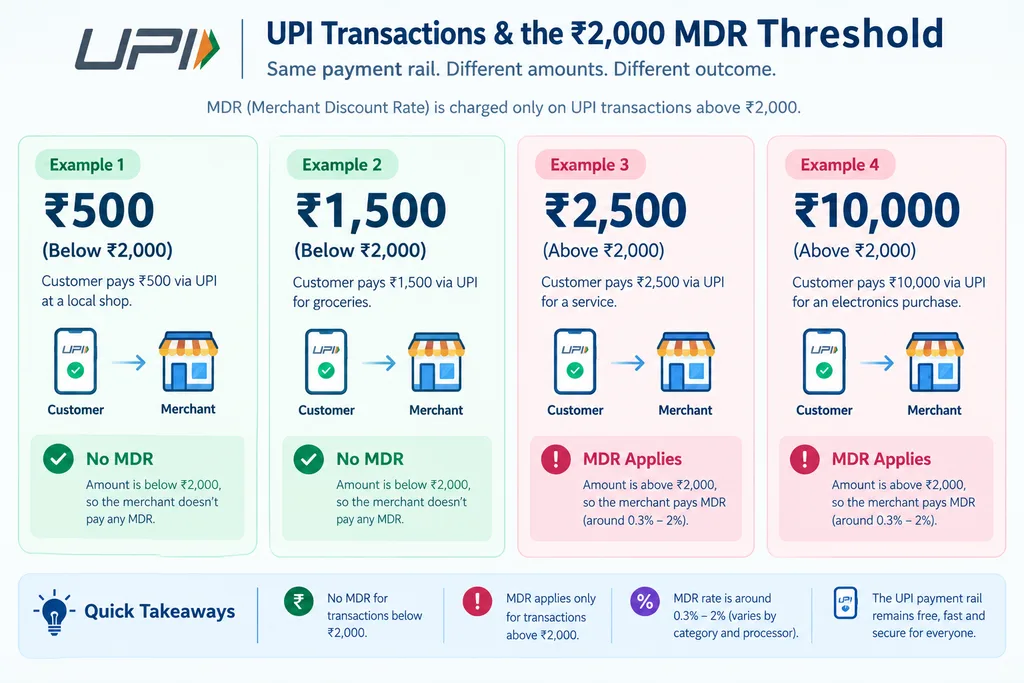
Example 1: ₹500 P2P transfer (friend to friend) No MDR applies to P2P at any amount. Cost to either party: ₹0. No income-tax event either, assuming it’s a genuine personal transfer.
Example 2: ₹1,500 merchant payment Below the ₹2,000 threshold. MDR: ₹0. GST on MDR: ₹0. Customer pays ₹1,500; merchant receives ₹1,500.
Example 3: ₹2,500 merchant payment (non-exempt category) Above the threshold. MDR at 0.4%: ₹10. GST at 18% on ₹10: ₹1.80. Merchant’s total cost: ₹11.80. Customer still pays ₹2,500. Merchant settlement: ₹2,488.20.
Example 4: ₹10,000 merchant payment MDR at 0.4%: ₹40. GST on ₹40: ₹7.20. Total cost to merchant: ₹47.20. Customer pays ₹10,000. Merchant settlement: ₹9,952.80.
Example 5: A business receiving ₹1,00,000 through UPI (high-value payment) Uncapped 0.4% would be ₹400, but the ₹300 cap applies at ₹75,000 and above, so MDR is capped at ₹300. GST at 18% on ₹300: ₹54. Total cost to merchant: ₹354. Customer pays ₹1,00,000 in full. Merchant settlement: ₹99,646, before any ITC the merchant later claims against its own GST liability.
None of these examples create any income-tax liability by themselves. Whether the ₹1,00,000 in Example 5 is taxable income depends entirely on what that payment represents (a genuine business sale, most likely) not on the fact that it arrived via UPI.
What Happens to P2P UPI Transfers?
Nothing changes. Peer-to-peer transfers, sending money to family, splitting a bill with friends, paying back a friend, remain completely free of MDR regardless of amount. NPCI’s framework and the Ministry of Finance’s public messaging around it both explicitly carve out P2P transfers and reaffirm that everyday consumer use of UPI stays free.
This matters because most viral “UPI tax” claims imagine an individual being charged for sending or receiving money. That scenario does not exist under the current or the new framework.
What Happens to Small Merchants?
Merchants whose UPI receipts total up to ₹1 lakh a month remain fully outside the MDR framework, regardless of individual transaction size. NPCI has stated this exemption is designed specifically to protect small shopkeepers, street vendors, and neighborhood stores, the segment most likely to be hurt by a blanket fee.
According to figures cited in coverage of the policy, transactions above ₹2,000 made up 15.1% of P2M UPI volume in FY23, rising to about 20.1% by the June quarter of FY27, and NPCI has stated that roughly 96% of UPI transactions overall remain unaffected by the new fee once P2P transfers, sub-₹2,000 payments, and exempt small merchants are all accounted for.
Is Money Received Through UPI Considered Taxable Income?
This is the question underneath most of the “UPI tax” anxiety, and the honest answer is: it depends entirely on what the money is, not on the fact that UPI moved it.
Personal transfers. Sending money to a friend, receiving a reimbursement, splitting a bill, or moving money between your own accounts is not income. UPI does not change that.
Income. Salary, freelance payments, consulting fees, business sales, rent received, commission, and other earnings are taxable under the normal provisions of income tax law that already apply to that category of income, whether paid in cash, by cheque, or by UPI.
Gifts. The tax treatment of a gift depends on existing income-tax provisions covering gifts: the relationship between giver and receiver, the amount, and applicable exemptions. UPI is only the delivery method; it does not create a new gift-tax rule.
Loans. A genuine loan received through UPI is not automatically treated as income. What matters is whether it is a real loan (with the usual characteristics: intent to repay, documentation where relevant) rather than income disguised as a loan.
Investments. Money moved via UPI to buy securities, mutual funds, or other assets is taxed according to the rules that already govern that investment and its eventual sale or maturity, not by the payment method used to fund it.
Refunds. A refund is the return of your own money, not income, regardless of the channel it comes back through.
Business receipts. If you run a business or work as a freelancer, UPI receipts should be recorded properly as part of your books and turnover, the same as any other receipt, because the underlying activity (business income) is what creates the tax obligation, not the payment rail.
None of the above is personalized tax advice. If your situation involves a specific transaction you’re unsure about, a chartered accountant can tell you how it applies to your facts.
Why Is India Introducing MDR on UPI?
Coverage of the policy attributes several rationales to different stakeholders. These are reported claims, not settled facts, and are presented here with that distinction intact.
- Government and NPCI framing: the zero-MDR era was subsidized through a government incentive scheme, and reintroducing a narrow, capped fee on higher-value merchant payments is being framed as a way to make the payment infrastructure, cybersecurity, and settlement systems financially sustainable without relying indefinitely on subsidies, while keeping everyday consumer use and small-merchant acceptance free.
- Industry/ecosystem framing: banks, payment service providers, and fintech apps have long argued that processing UPI transactions at zero cost isn’t commercially sustainable at UPI’s current transaction volumes, and that a fee on higher-value merchant transactions lets them continue investing in fraud prevention, uptime, and acceptance infrastructure.
- Tax administration framing: tax professionals quoted in coverage note the move also creates a new, if modest, GST revenue stream, estimated by at least one named expert at roughly ₹3,500–4,000 crore a year, though this figure should be read as an expert’s estimate, not an official Finance Ministry projection.
Government officials, industry bodies, and analysts do not necessarily agree on which of these motivations mattered most, and this article does not take a position on which explanation is “the real reason.” Readers should treat each of the above as an attributed claim from its respective source.
Potential Benefits and Concerns
Potential benefits, as reported or reasonably implied by official statements:
- Generates a funding stream for payment infrastructure and cybersecurity that doesn’t depend entirely on government subsidy.
- Keeps P2P transfers and small-value/small-merchant P2M payments completely free, preserving UPI’s core value proposition for most users.
- GST-registered merchants can offset the GST-on-MDR cost through input tax credit, limiting the real net burden for many businesses.
- A capped fee (₹300 max) limits how much even very high-value transactions cost in fees.
Potential concerns raised by critics, merchants, or analysts:
- Merchants processing frequent above-₹2,000 transactions, restaurants, retail stores, service providers, will see a new recurring cost that didn’t exist before.
- Non-GST-registered merchants, or those without enough output GST liability to absorb the credit, bear the GST-on-MDR cost more directly.
- Reported industry concern about bill-splitting: since there’s no daily cap on the number of sub-₹2,000 transactions, some analysts have suggested the threshold could be worked around by breaking a single purchase into multiple smaller payments, which could complicate reconciliation and undermine the intent of the threshold.
- Added accounting and GST compliance complexity for merchants who now need to track MDR and the associated GST separately from their core sales records.
- Concerns raised by some commentators that merchants might try to steer higher-value customers toward cash to avoid the fee, though this is a stated concern rather than an observed outcome at this stage since the policy hasn’t taken effect yet.
This article does not conclude which side is “right.” The actual effect on merchant behavior, consumer habits, and cash usage will only be observable after the October 15, 2026 rollout and subsequent data.
Impact by User Type
| User type | What changes? | What does not change? | Potential practical impact |
|---|---|---|---|
| Student | Nothing directly | Sending/receiving money via UPI, paying for small purchases | None, unless paying a merchant above ₹2,000, and even then the cost falls on the merchant |
| Salaried employee | Nothing | Salary credit, personal UPI spending, P2P transfers | None; UPI usage for personal expenses is unaffected regardless of the payment method the employer uses |
| Freelancer | No new charge on receiving payments via UPI | Income-tax treatment of freelance income (unchanged; based on the nature of the income, not the app) | Should keep clean records of client payments as always; UPI receipts are not separately taxed |
| Small shopkeeper (under ₹1 lakh/month via UPI) | Nothing | Full MDR exemption continues | None |
| Street vendor | Nothing, if under the monthly threshold | Zero-MDR status for small-value acceptance | None for most vendors given typical daily transaction sizes |
| GST-registered business (above ₹1 lakh/month, transactions over ₹2,000) | Starts paying MDR + GST on MDR from Oct 15, 2026 | GST treatment of actual sales is unchanged | New line-item cost to track; largely offsettable via ITC |
| Large business/retail chain | New recurring MDR + GST-on-MDR cost on above-₹2,000 UPI payments | Core GST/income-tax obligations on sales unchanged | Needs settlement reconciliation and accounting updates before Oct 15, 2026 |
| Online seller | New MDR cost applies if UPI is used for above-₹2,000 orders and the seller isn’t otherwise exempt | Underlying tax treatment of sales | May need to review payment gateway settlement reports for the new deduction |
| Service provider (consultants, agencies) | New MDR cost on above-₹2,000 UPI client payments, if not covered by the small-merchant exemption | Income-tax treatment of fees earned | Track the fee separately from gross receipts for bookkeeping |
| Rural merchant | Generally unaffected if under the ₹1 lakh/month threshold | Free UPI acceptance for small-value sales | Limited impact for most rural micro-merchants |
| Consumer (any) | Nothing | Pays exactly the listed price; cannot legally be charged extra for UPI | None |
Impact by Transaction Type
| Transaction | Is UPI itself taxable? | Possible tax/charge | Who is affected? |
|---|---|---|---|
| P2P transfer | No | None | Nobody; always free |
| P2M under ₹2,000 | No | None | Nobody |
| P2M above ₹2,000 (non-exempt) | No | 0.4% MDR (capped ₹300) + 18% GST on that MDR | Merchant only |
| P2M above ₹2,000 (railways/telecom/insurance/fuel) | No | Flat ₹5 MDR + GST on that ₹5 | Merchant only |
| Salary | No, based on payment method | Income tax on the salary itself, per existing slabs/rules | Employee, as always |
| Freelance payment | No | Income tax on the freelance income itself | Freelancer, as always |
| Business sale | No | Income tax on profit, GST on the sale itself if applicable, plus MDR if it’s a qualifying P2M payment | Business |
| Gift | No | Depends on existing gift-tax provisions (relationship, amount, exemptions) | Recipient, based on existing rules |
| Loan | No | None, if genuinely a loan | Neither party, if properly documented |
| Reimbursement | No | None | Neither party |
| Own-account transfer | No | None | Nobody |
| Refund | No | None | Nobody; it’s a return of your own money |
| Rent | No | Income tax on rental income, as already applicable | Landlord, as always |
| Investment-related payment | No | Tax rules of the specific investment/asset apply | Investor, based on that investment’s rules |
Common Myths About UPI Tax
1. “Every UPI payment above ₹2,000 is taxed.” No. Above ₹2,000, a merchant payment may attract MDR, a processing fee, not a tax on you.
2. “The sender pays UPI tax.” No. The sender pays exactly the transaction amount. MDR, where applicable, is deducted from the merchant’s settlement.
3. “Receiving money through UPI automatically creates income tax.” No. Taxability depends on what the money represents, not the payment app.
4. “MDR is the same as income tax.” No. MDR is a commercial processing fee; income tax is a tax on your earnings.
5. “GST is charged on the entire UPI transaction.” No. GST applies only to the MDR fee itself, not the transaction amount.
6. “P2P transfers are charged now.” No. P2P remains free at any amount under the new framework.
7. “Small merchants are affected.” No, provided they receive up to ₹1 lakh a month via UPI, which covers the vast majority of small shopkeepers and vendors.
8. “Merchants can add the MDR to your bill.” No. NPCI’s framework explicitly prohibits merchants and UPI apps from passing this charge to consumers.
9. “Using UPI makes your money automatically taxable because it’s traceable.” No. Digital traceability can help with recordkeeping and reconciliation, but it doesn’t change whether a receipt is legally taxable; that always depended on the nature of the money.
10. “Paying your taxes through UPI creates another tax.” No. Using UPI to pay income tax, advance tax, or GST is simply a payment channel; it doesn’t add any additional charge on top of the tax you already owe.
UPI, Records, and Income Tax Compliance
UPI transactions can and do form part of a business’s or individual’s financial records, the same way bank statements and card statements always have. This is not new or unique to UPI; it’s simply how digital payments work.
For businesses, this means UPI receipts should be reconciled against invoices and recorded properly as part of turnover, because unexplained or poorly documented receipts, from any payment method, can create scrutiny during a tax assessment. That risk exists regardless of whether the money arrived via UPI, cash, or cheque; it comes from the recordkeeping gap, not from UPI specifically.
For individuals, the important distinction to hold onto is this: a transaction being recorded digitally is not the same as a transaction being taxable. Your salary showing up as a UPI credit doesn’t make it “more taxable” than if it arrived by bank transfer; it was always taxable as salary. A gift from a relative arriving by UPI isn’t newly exposed to tax that it wasn’t already subject to under existing gift-tax provisions.
There is no verified basis for claims that UPI usage triggers automatic reporting to tax authorities purely because of transaction volume or amount, beyond the general recordkeeping and compliance obligations that already apply to businesses and taxpayers under existing law.
What Should Businesses Do?
Practical, non-personalized steps for merchants and freelancers ahead of October 15, 2026:
- Maintain proper invoices for every sale, regardless of payment method.
- Reconcile UPI settlements against gross sales figures once MDR deductions begin appearing in settlement reports.
- Separate business and personal UPI transactions where you currently mix them, since mixed usage makes reconciliation harder.
- Track MDR paid as a distinct line item in your books, the same way payment-gateway fees are already tracked for card or online payments.
- Track GST charged on MDR separately, so you can accurately claim input tax credit if you’re GST-registered.
- Keep settlement reports from your acquiring bank or payment aggregator; these will show the MDR and GST deductions transaction by transaction.
- Account for refunds properly, since a refunded transaction shouldn’t be counted as retained income.
- Reconcile bank statements monthly against UPI settlement reports to catch discrepancies early.
- Consult a qualified tax professional for anything specific to your business structure, GST registration status, or ITC eligibility; this article covers the general framework, not your specific filing.
A simple worked accounting example. Say a small retail store receives ₹40,000 in UPI payments in a day, made up of a mix of transactions, some below ₹2,000, some above. Suppose ₹25,000 of that total came from transactions individually above ₹2,000 and subject to MDR. At 0.4%, that’s ₹100 in MDR, plus ₹18 in GST on that MDR (18% of ₹100), for a total processing cost of ₹118 on the day. The store’s gross UPI collection was ₹40,000; net settlement after MDR and GST on MDR would be ₹39,882, before the store later claims the ₹18 in GST paid as input tax credit against its own GST liability, if it is GST-registered.
UPI Taxation Timeline in India
- 2016: UPI launches, built and operated by NPCI.
- 2016–2019: UPI adoption grows; MDR exists on P2M transactions during this period.
- December 30, 2019: CBDT gazette notification removes MDR on P2M UPI transactions, effective January 2020.
- From FY2021-22: A government incentive scheme begins, compensating banks and PSPs to sustain zero-MDR UPI acceptance for low-value P2M transactions, with recorded payouts rising from roughly ₹1,389 crore (FY2021-22) to roughly ₹3,631 crore (FY2023-24).
- April 18, 2025: Ministry of Finance publicly denies viral claims of a proposed GST on UPI transactions above ₹2,000, confirming no MDR (and therefore no GST) applied to UPI at that time.
- August 2026 (Monsoon Session): Statutory amendments reported to enable a revised MDR framework are passed by Parliament.
- September 14, 2026: Finance Ministry gazette notification reported ahead of the NPCI circular.
- September 15, 2026: NPCI issues the circular finalizing the 0.4% MDR structure, the ₹300 cap, the flat ₹5 rate for specified categories, and the ₹1 lakh/month small-merchant exemption.
- October 15, 2026: The new MDR framework takes effect.
- Ongoing: NPCI and the Finance Ministry are expected to issue further clarifications as implementation questions (such as merchant categorization and split-transaction handling) surface after rollout; treat any date, rate, or threshold in this article as subject to future circulars.
Frequently Asked Questions
Is UPI taxable in India? No. UPI itself is a payment method, not a taxable event. What may be taxable is the underlying transaction (income, business sale, and so on), the same as with any other payment method.
Is there a UPI tax above ₹2,000? No tax. Above ₹2,000, certain merchant (P2M) payments attract an MDR processing fee from October 15, 2026, paid by the merchant, not the customer.
Who pays MDR on UPI? The merchant, deducted by their acquiring bank from the settlement amount.
Is MDR a tax? No. It’s a commercial payment-processing charge, similar to fees merchants have long paid on card transactions.
Does GST apply to UPI payments? Not to the payment amount. GST at 18% applies to the MDR fee itself, where MDR is charged.
Are UPI-to-UPI (P2P) transfers free? Yes, at any amount, under both the old and new frameworks.
Will customers have to pay MDR? No. NPCI’s framework explicitly prohibits merchants and UPI apps from charging customers extra for UPI payments.
Are small merchants exempt? Yes. Merchants receiving up to ₹1 lakh a month via UPI stay outside the MDR framework entirely.
Does receiving money through UPI count as income? Only if the money is actually income by nature (salary, business receipts, and so on). UPI doesn’t change how income tax law treats a receipt.
Can UPI transactions affect income-tax compliance? UPI receipts form part of normal financial records, the same as bank or card statements. Good recordkeeping matters regardless of payment method; UPI doesn’t create new reporting obligations by itself.
What happens if a merchant receives ₹10,000 through UPI? If it’s a single P2M transaction above ₹2,000, 0.4% MDR (₹40) plus 18% GST on that MDR (₹7.20) applies, deducted from the merchant’s settlement. The customer still pays ₹10,000.
What is the difference between MDR and GST here? MDR is the underlying processing fee. GST is a tax charged on top of that fee, because payment processing is treated as a taxable service.
Why is MDR being reintroduced on UPI? Reported reasons include funding payment infrastructure and cybersecurity without indefinite government subsidy, and industry pressure to make high-volume UPI processing commercially sustainable. These are attributed rationales, not a single confirmed official explanation.
Disclaimer
This article is for educational and informational purposes. Tax rules and payment policies can change, and individual tax treatment depends on the underlying transaction and the taxpayer’s specific circumstances. Readers dealing with significant amounts, GST registration questions, or specific compliance issues should verify the latest official NPCI/RBI/CBIC circulars or consult a qualified tax professional.
Conclusion
There is no such thing as a “UPI tax” in Indian law, and there isn’t one after October 15, 2026 either. What exists is a narrow, capped MDR fee that certain merchants pay on P2M payments above ₹2,000, with GST charged on that fee rather than on your money. Everyday P2P transfers, small purchases, and small-merchant acceptance remain exactly as free as they’ve always been.
If you take one thing from this guide, let it be this: the tax status of any money you receive depends on what that money is, not on the app you used to move it. If you run a business processing higher-value UPI payments, start tracking MDR and GST-on-MDR in your books now, before October 15, so the new deduction doesn’t surprise you on your first settlement report under the new framework.