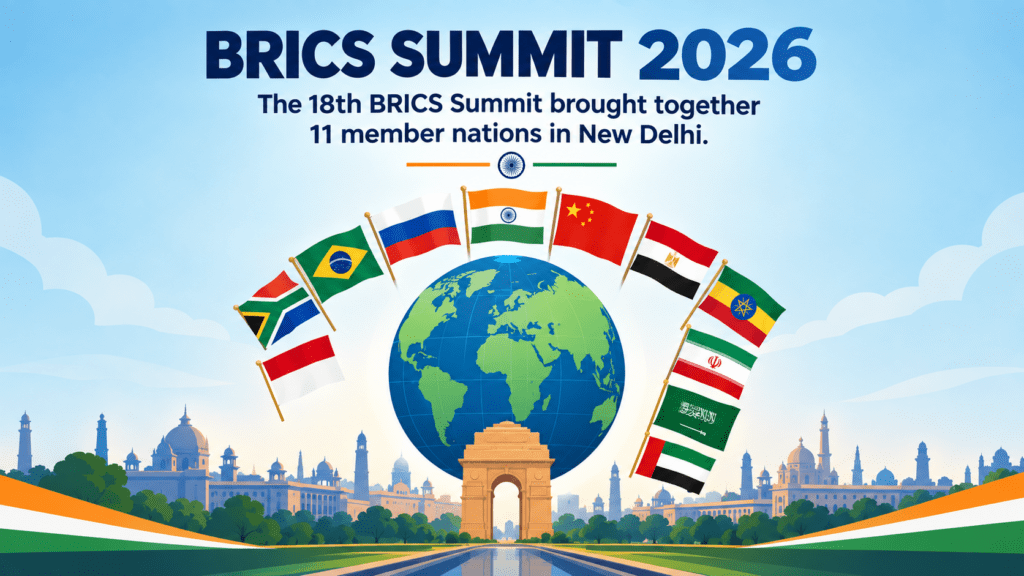
BRICS Summit 2026 has just concluded in New Delhi, and it touched more of India’s economy than most headlines suggest. India hosted all 11 member nations at Bharat Mandapam on September 12 and 13, 2026, under the theme “Building for Resilience, Innovation, Cooperation and Sustainability.” If you build products, run a business, or just pay attention to prices at the pump, this summit touched things you actually care about. Let us break down what was actually confirmed, what is likely to follow, and what remains a possibility rather than a promise.
This is not a summary of speeches. It is a look at what the New Delhi Declaration and the surrounding announcements could mean for Indian trade, payments, energy, jobs, and technology over the next few years.
What Happened at BRICS Summit 2026 in New Delhi?
BRICS leaders unanimously adopted the New Delhi Declaration on September 12, 2026, a 140-point document covering trade, technology, finance, energy, and global governance. The consensus was notable because it came together despite sharp disagreements between UAE and Iran over the West Asia conflict, and it followed a BRICS foreign ministers’ meeting in May 2026 that had failed to produce a joint statement at all.
BRICS now has 11 full members: Brazil, Russia, India, China, South Africa, Egypt, Ethiopia, Indonesia, Iran, Saudi Arabia, and the UAE, plus ten more countries admitted as Partner Countries in 2025, including Malaysia, Nigeria, Thailand, Vietnam and Uzbekistan. Russian President Vladimir Putin and Chinese President Xi Jinping both attended in person. China takes over the BRICS chairship for 2027.
Confirmed: the declaration was adopted, it covers 140 points, and it does not create a common BRICS currency. Likely: the practical follow-through will happen gradually through working groups, task forces and ministerial meetings over the next year. Possible: some of the more ambitious proposals, like linked digital currencies, may take years to move from discussion to implementation, if they move at all.
What BRICS Summit 2026 Means for India
Getting 11 countries with genuinely different interests to agree on anything in the middle of an active West Asia conflict is not a small diplomatic achievement. For India specifically, hosting a BRICS Summit 2026 that produced consensus, rather than a repeat of the failed May meeting, strengthens its credibility as a bridge-builder heading into its next BRICS-related commitments.
The Biggest Economic Takeaways for India
Strip away the geopolitics and a handful of economic threads stand out for India: a push toward local-currency trade, a formal AI cooperation framework, a new BRICS Startup Innovation Fund proposal, continued energy security language, and renewed attention to India’s trade deficit with the bloc. None of these rewrite India’s economy overnight. All of them nudge it in a direction worth tracking.
The declaration also criticized “unilateral tariff and non-tariff measures” without naming any country, language widely read as a response to the tariffs the United States imposed on several BRICS members, including India, over the past year.
BRICS and India’s Trade: Opportunity Meets a Widening Deficit
India’s trade with the other 10 BRICS members has more than doubled over five years, from about $203 billion in FY2021 to $417.5 billion in FY2026. That sounds like a win until you look at the split: India exported $95.7 billion worth of goods to BRICS partners in FY2026, while it imported $321.8 billion, leaving a deficit of $226.1 billion. That gap now accounts for nearly 68% of India’s entire merchandise trade deficit.
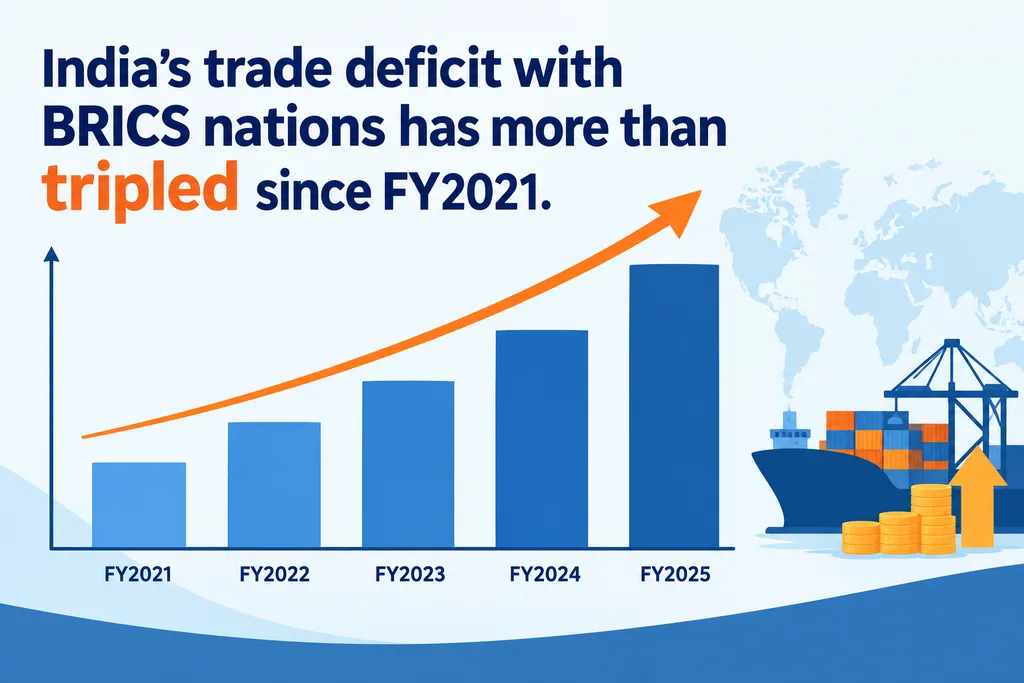
Three countries explain most of the imbalance. China alone accounts for close to half of it, importing $131.6 billion worth of Indian goods while India imports far more the other way. Russia is the second-largest contributor, driven almost entirely by discounted crude oil purchases that began after 2022. The UAE, where India has a free trade agreement, adds to the gap mainly through oil imports as well.
On the export side, the UAE is actually India’s biggest BRICS market, absorbing $37.4 billion in FY2026, up 124% since FY2021. China follows at $19.5 billion, then Saudi Arabia at $10.3 billion. Sectors with real momentum include pharmaceuticals, IT and software services, engineering goods, and textiles, though the BRICS Summit 2026 did not announce sector-specific trade deals for any of these.
Confirmed: India’s BRICS trade deficit is real, growing, and concentrated in three countries. Likely: India will keep pushing to diversify exports toward China, Russia and Indonesia rather than relying on a handful of import-heavy relationships. Possible: stronger BRICS trade facilitation measures, like the digitisation of trade documents mentioned in the declaration, could eventually make it easier for Indian exporters to compete, but there is no confirmed timeline for this.
What This Means for India
If you run a business that exports to BRICS markets, the BRICS Summit 2026 language on reducing non-tariff barriers and digitising trade documentation is worth watching, but it is not yet a specific policy you can act on. If you import from China, Russia or the UAE, nothing here suggests costs will fall in the near term.
Could BRICS Change How India Pays for International Trade?
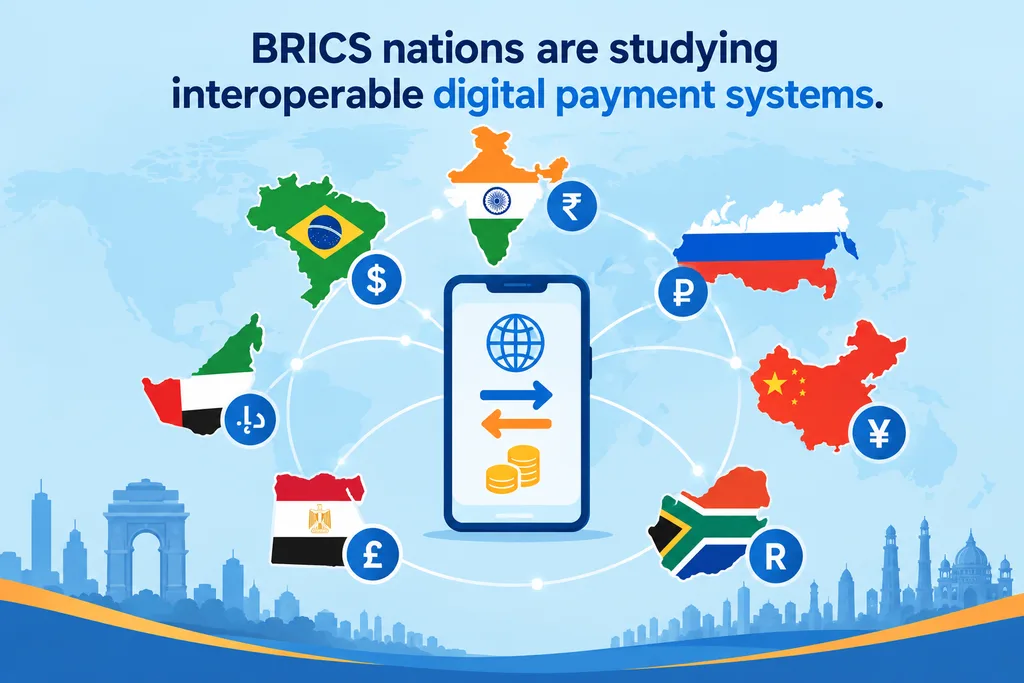
This is where a lot of the excitement, and a lot of the confusion, tends to concentrate. The BRICS Payment Task Force is studying interoperability between different countries’ payment and messaging systems, alongside greater use of local currencies for trade settlement. Officials also floated linking central bank digital currencies, connecting India’s digital rupee with China’s digital yuan, Brazil’s Pix and similar systems, so that trade and tourism payments could settle directly without routing through a third currency.
Commerce Minister Piyush Goyal used the BRICS Summit 2026 Business Forum to push this further, pointing out that UPI already processes more than 250 billion transactions a year and is accepted in 11 countries. His pitch was for UPI to become one of the connecting rails of a broader BRICS payment network, not for every BRICS country to adopt UPI outright.
None of this created a single BRICS payment platform. What it created is a shared direction: more local-currency settlement, more interoperability studies, and continued interest in linking India’s digital public infrastructure with other countries’ systems.
Confirmed: the BRICS Payment Task Force exists and is actively studying interoperability. Likely: more bilateral pilots for local-currency settlement and UPI-style QR acceptance in specific travel and remittance corridors. Possible: a technically linked CBDC network across BRICS members, though this faces real interoperability, governance and trust hurdles and has no confirmed launch date.
BRICS, the Rupee and the Dollar: What’s Actually Changing
Here is the single most misreported part of every BRICS summit: no BRICS currency was launched, and none was proposed at the BRICS Summit 2026 either. India’s Ministry of External Affairs confirmed directly after the summit that there is no current proposal for a common BRICS currency. What the declaration does support is trade and investment in members’ own local currencies, alongside faster, cheaper and more transparent cross-border payments.
There is an important difference between these two things. Reducing dependence on the dollar for specific transactions, like settling a bilateral trade deal in rupees and rubles instead of dollars, is something that is already happening in a limited way. Replacing the dollar as the world’s reserve currency is a completely different scale of change, and nothing announced at the BRICS Summit 2026 moves that needle in any measurable way.
Confirmed: no BRICS currency exists or was proposed at the 2026 summit. Likely: more bilateral local-currency trade agreements, building on arrangements already in place with Russia and a few other partners. Possible: the dollar’s role in India’s own trade could shrink gradually over years, but this depends on decisions by dozens of trading partners, not just BRICS members.
What This Means for India
If a headline tells you BRICS just “killed the dollar” or “launched a new currency,” it is wrong. What actually happened is more boring and more useful: a continued, incremental push to settle more trade in national currencies where it makes practical sense.
What BRICS Means for India’s Energy Security
Energy security got explicit attention in the New Delhi Declaration, which called for stable energy markets, protection of energy infrastructure, and “undisrupted flows of energy from diverse sources.” That language matters to India because energy imports move directly into transportation and manufacturing costs, which move into inflation, which affects every business and household in the country.
Russia remains central to this story. President Putin reaffirmed Russia’s role as what he called a reliable supplier of oil, gas and coal to India, even as India has faced US pressure, including a 50% tariff earlier in 2025, over its continued purchases of discounted Russian crude. India has already reduced some Russian oil imports in response to that pressure, so the BRICS Summit 2026 energy language reflects an ongoing balancing act rather than a new commitment.
Confirmed: the declaration includes explicit energy security language and calls for stable, diversified energy flows. Likely: India will keep buying discounted Russian crude where it makes economic sense, while diversifying suppliers to manage geopolitical risk. Possible: deeper BRICS energy cooperation, including renewable energy partnerships, though the declaration’s language here stays general rather than specific.
What This Means for India
Nothing here changes fuel prices this week. But a bloc that includes Russia, Saudi Arabia, the UAE and Iran, four major energy producers, staying aligned on “diverse sources” and infrastructure protection is a mild long-term tailwind for the price stability Indian consumers ultimately feel at the pump.
Investment, Manufacturing and the New Development Bank
The New Development Bank, founded by the original BRICS five in 2015, remains India’s most concrete BRICS-linked financing channel. NDB has committed $35.6 billion across 108 projects since inception, and nearly $10 billion of that has gone directly into Indian infrastructure, including the Mumbai, Chennai and Indore metro systems and the Delhi-Ghaziabad-Meerut Regional Rapid Transit System. A 2025 agreement between NDB and India’s own National Bank for Financing Infrastructure and Development set up a framework for joint infrastructure and clean-energy financing going forward.
This is the part of the BRICS story that is easiest to overstate and easiest to understate at the same time. NDB financing is real and already flowing, but it is one financing source among many for a country that needs an estimated $4.5 trillion in infrastructure investment by 2030, according to government think tank NITI Aayog. BRICS membership does not automatically pull in foreign direct investment; it opens a channel that Indian institutions still have to use effectively.
Confirmed: NDB has an active $10 billion India portfolio and a fresh MoU for further clean-energy and transport financing. Likely: continued, incremental NDB lending for Indian metro, rail and renewable energy projects. Possible: a larger role for NDB in India’s broader infrastructure gap, depending on how quickly the bank can scale lending relative to India’s total financing needs.
Opportunities for Indian Startups and Technology Companies
This is where the BRICS Summit 2026 went further than most previous editions. The declaration backs a new BRICS startup incubator network and floats a proposed BRICS Startup Innovation Fund. It also welcomes a Risk Lab pitched for India’s GIFT City financial hub in Gujarat, and it commits members to implementing the BRICS Leaders’ Statement on the Global Governance of Artificial Intelligence, building on India’s own AI Impact Summit held in New Delhi in February 2026.
For India’s technology sector, that combination points to three genuine areas of opportunity: fintech companies working on cross-border payments and MSME credit assessment, AI companies that can operate within a shared governance framework spanning multiple emerging markets, and startups that could tap a BRICS-wide innovation fund if it moves from proposal to reality. The declaration also flagged a “Jaipur Consensus” on invoice discounting for BRICS MSMEs, aimed at helping smaller exporters unlock working capital instead of waiting on long payment cycles.
Confirmed: the AI governance statement, the startup incubator network, and the Jaipur Consensus on MSME invoice discounting were all referenced in the declaration. Likely: Indian fintech and payments companies will find early, practical opportunities in BRICS corridor pilots before any innovation fund becomes operational. Possible: the BRICS Startup Innovation Fund could become a real capital source for Indian founders, but it is currently a proposal, not a funded, running program.
BRICS vs G7: What Actually Changes for India?
It is tempting to frame this as BRICS against the West, but that framing does not match how India actually behaves. India is a full member of BRICS, a member of the G20, a Quad partner alongside the US, Japan and Australia, and it continues to engage with the IMF, World Bank and WTO on its own terms. The New Delhi Declaration itself criticized unilateral tariffs and pushed for reformed multilateral institutions without abandoning those institutions.
India’s position is better described as strategically independent than as aligned with one bloc against another. It buys discounted Russian oil, negotiates trade terms with the US, deepens ties with China through forums like the BRICS Summit 2026, and pursues UPI’s global expansion through its own bilateral deals, often all in the same month. That flexibility is a deliberate choice, not a contradiction.
The Risks India Needs to Watch
BRICS is not automatically good for India, and the BRICS Summit 2026 outcomes come with real trade-offs.
- Trade imbalance risk: India’s growing BRICS trade deficit, especially with China, could deepen if exports do not diversify faster than imports grow.
- Geopolitical exposure: aligning too closely with Russia or China on any single issue carries diplomatic costs with Western trading partners, including the US, which has already used tariffs as leverage over India’s Russian oil purchases.
- Payment fragmentation: multiple competing local-currency and CBDC initiatives across BRICS members could create technical fragmentation rather than the smooth interoperability the declaration describes.
- Consensus fragility: the bloc nearly failed to agree on a joint statement in May 2026, and disagreements between members like Iran, Saudi Arabia and the UAE could resurface on future issues.
- Uneven benefit distribution: larger economies like China are positioned to capture more of any new BRICS trade or investment flow than India is, given China’s existing scale advantage within the bloc.
For every opportunity discussed above, there is a corresponding version of “this could just as easily not happen,” and that is worth remembering before treating any BRICS announcement as a guarantee.
Three Possible Futures for India
Nobody, including the people who wrote the declaration, knows exactly how far BRICS economic cooperation will actually go. Three broad scenarios are worth holding in mind.
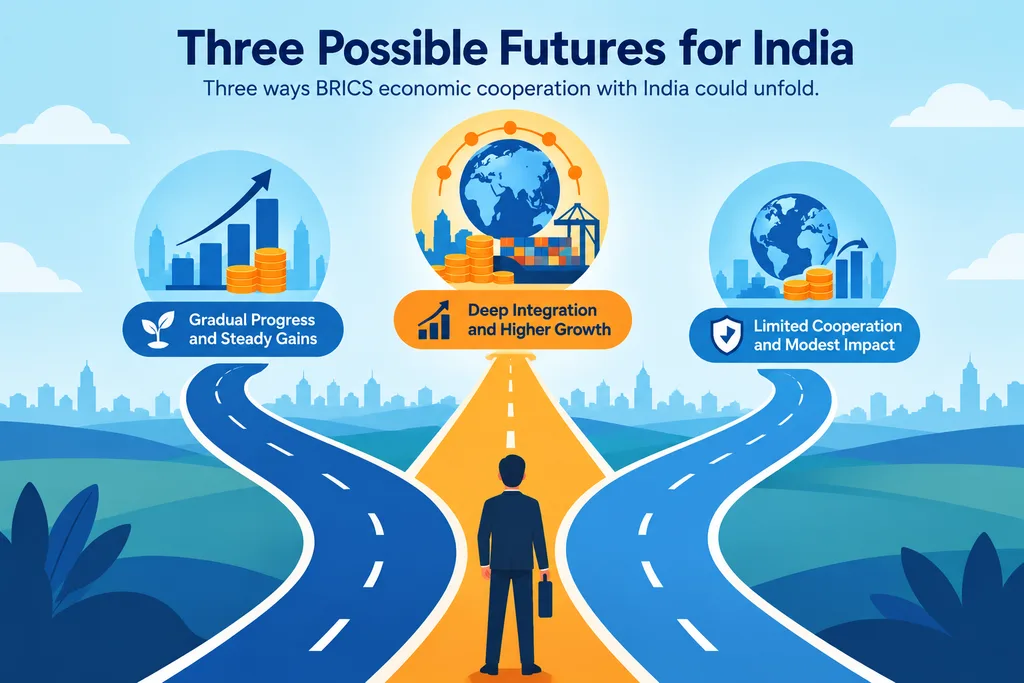
Scenario A, Gradual Integration: local-currency settlements expand slowly, NDB lending to India continues at roughly its current pace, and the startup incubator network launches without a fully funded innovation fund behind it yet. This is the most likely path based on how BRICS has moved historically.
Scenario B, Faster Economic Integration: the BRICS Payment Task Force delivers working interoperability pilots within two to three years, the Startup Innovation Fund gets capitalized, and India’s export diversification efforts start narrowing the trade deficit with China and Russia. This would meaningfully benefit Indian exporters, fintechs and infrastructure firms, but would also require sustained political will across 11 governments with different priorities.
Scenario C, Limited Economic Impact: BRICS remains primarily a diplomatic and coordination forum, similar to how it has functioned for much of the past decade, with declarations that sound ambitious but translate into modest, incremental change. Given the bloc’s track record of studying more than implementing, this outcome cannot be ruled out.
| Scenario | What Changes | Potential Benefit for India | Major Risk |
|---|---|---|---|
| Gradual integration | Slow rollout of local-currency trade, steady NDB lending, incubator network launches without full funding | Steady, low-risk gains in financing and payment options | Progress may feel too slow to shift India’s trade deficit meaningfully |
| Faster integration | Working payment interoperability, funded startup fund, active export diversification | Cheaper cross-border payments, new capital for startups, narrower trade deficit | Requires sustained consensus across 11 governments with different interests |
| Limited integration | Declarations continue, but implementation stays modest | Diplomatic and reputational gains for India’s Global South leadership | Economic expectations built up around the summit go largely unmet |
How Could BRICS Affect Ordinary Indians?
Consumers: energy security language could support price stability at the margins, but nothing here changes fuel or import prices immediately. Imported electronics and machinery from China remain part of India’s BRICS import bill.
Businesses: exporters to UAE, Saudi Arabia and other BRICS partners have a genuine growth market, but importers dependent on Chinese and Russian goods will not see cost relief from the BRICS Summit 2026 alone.
Startups: the proposed BRICS Startup Innovation Fund and the startup incubator network are worth watching closely over the next one to two years, especially for founders in fintech, AI, and cross-border commerce.
Students and early-career workers: AI governance cooperation and continued semiconductor and manufacturing investment support long-term demand for AI, cybersecurity, and advanced manufacturing skills, though these opportunities depend on India’s own domestic policy execution as much as on BRICS.
BRICS India Economy Timeline
- 2009: First BRIC summit held in Yekaterinburg, Russia.
- 2010: South Africa joins, forming BRICS.
- 2015: New Development Bank established by the founding five members.
- 2021: India hosts its third BRICS summit, held virtually.
- 2024: Egypt, Ethiopia, Iran and the UAE join as full members.
- January 2026: India assumes the BRICS chairship for 2026.
- February 2026: India hosts the AI Impact Summit in New Delhi, later referenced in the BRICS AI governance statement.
- May 2026: BRICS foreign ministers meet in New Delhi but fail to agree on a joint statement.
- September 12 to 13, 2026: India hosts the 18th BRICS Summit; the New Delhi Declaration is adopted unanimously.
- 2027: China assumes the BRICS chairship and hosts the 19th summit.
Should Indians Care About BRICS?
Yes, but with calibrated expectations. The BRICS Summit 2026 did not transform India’s economy, and it was never going to. Its real significance sits in a handful of gradual, trackable shifts: continued local-currency trade experiments, a genuine but young push toward payment interoperability, steady New Development Bank financing for Indian infrastructure, and a new, still-unfunded, opening for startups through the proposed incubator network and innovation fund.
Whether India actually captures these gains depends less on what BRICS declares and more on what India does next. That means whether Indian exporters can out-compete import growth from China and Russia, whether the RBI and NPCI can turn payment interoperability talk into working pilots, and whether domestic manufacturing and AI policy can absorb the opportunities this bloc is nudging toward India’s door. The summit opened a door. Walking through it is India’s job, not BRICS’s.
10. FAQ
Frequently Asked Questions
Did BRICS launch a new currency at the 2026 summit? No. India’s Ministry of External Affairs confirmed there is no current proposal for a common BRICS currency. The declaration supports trade in local currencies and improved cross-border payments instead.
How big is India’s trade deficit with BRICS countries? India’s trade deficit with the other 10 BRICS members reached $226.1 billion in FY2026, driven mostly by imports from China, Russia and the UAE.
What is the New Development Bank and how does it help India? The NDB is a multilateral development bank founded by BRICS in 2015. It has committed nearly $10 billion to Indian infrastructure projects, including several metro systems and a rapid transit line.
Will BRICS affect UPI or India’s digital payments? BRICS discussions support linking payment systems and expanding UPI-style interoperability, and UPI is already accepted in 11 countries. No formal multilateral UPI-BRICS integration agreement was signed at this summit.
Is BRICS replacing the US dollar? No. The declaration supports local-currency trade for specific transactions, which is different from replacing the dollar as the global reserve currency. Economists describe this as a slow, partial shift rather than a replacement.