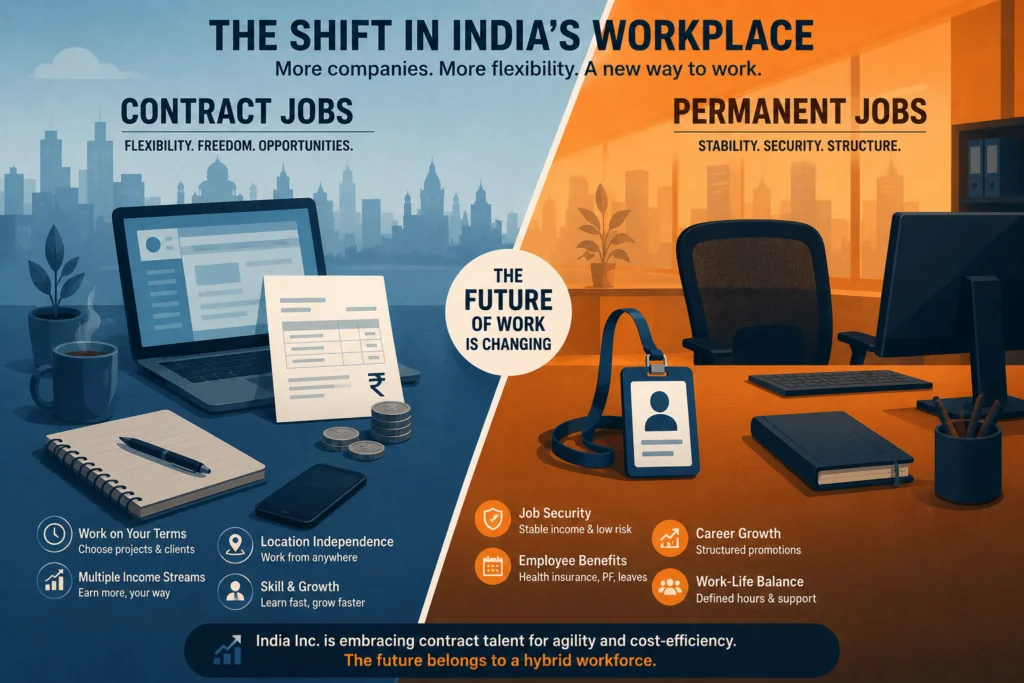
Contract jobs in India are no longer a niche hiring tactic they’re a real fork in the road for anyone building a career here, from a fresher weighing a fixed-term offer to a developer being pitched a “flexible” consulting deal instead of a full-time role.
The instinctive read is that companies use contract jobs to dodge the cost of a full-time employee. That story isn’t wrong, but it’s incomplete. What actually differs under Indian law between an employee and a contractor depends on how the worker is classified and misclassifying that relationship carries real legal risk for the employer, not just a PR problem.
This piece looks at why Indian companies are leaning into contract jobs, what genuinely changes in cost and obligation, what the law says about who counts as an employee, and whether “contract jobs replacing permanent jobs” is even the right way to describe what’s happening.
Also Read: Blockchain Technology: Why Countries Should Adopt It As Soon As Possible in 2026
Why Indian Companies Are Choosing Contract Jobs
Cost flexibility drives contract jobs over permanent hiring
Permanent hiring locks a company into fixed salary and statutory obligations that continue regardless of how a project performs. Contract jobs convert part of that fixed cost into a project-linked cost a company staffing a six-month build can release the budget line when the project ends instead of carrying headcount indefinitely. This isn’t automatic cost avoidance; it’s cost restructuring, and whether it also avoids statutory obligations depends on classification, covered below.
Faster hiring
A permanent hire in India usually means a multi-stage interview process and a notice-period wait. Contract jobs can start within days once a rate and scope are agreed, because they typically skip the approval layers built around headcount additions.
Specialised, time-bound skills
A fintech company migrating its payments stack might need an integration specialist for four months, not five years. Contract jobs let a company access that skill for exactly as long as it’s needed, without the obligation to find the person new work afterward.
Startup runway economics
Early-stage founders operate against a burn-rate clock. Many deliberately keep the core permanent team small product, leadership, senior engineering and route functions like design or DevOps through contract jobs or agencies instead.
India’s IT and outsourcing engine
India’s IT services sector has run a blended model permanent core plus project-based staff augmentation for two decades, largely because client contracts are themselves project-based. Staffing industry data shows IT staffing adding formal employment at double-digit annual growth even in periods when permanent IT hiring slowed, with flexi-staffing overall crossing roughly 1.9 million formal workers in FY26. That scale is a major reason contract jobs now get discussed as an industry-wide shift rather than a one-off tactic.
What Companies Actually Save on Contract Jobs
This is where most coverage oversimplifies. Not every worker in contract jobs is excluded from EPF, ESI, gratuity, or leave it depends entirely on classification. Before totalling savings, separate the categories, because Indian law treats them differently.
- Permanent employee – on payroll, under the company’s control over how work is done, covered by the full statutory benefit bundle.
- Fixed-term employee – on payroll for a defined period, doing comparable work to a permanent employee. Under the labour code framework, fixed-term employees are meant to get wages, benefits, and conditions on par with permanent staff including gratuity after just one year of service, versus five years for permanent employees.
- Contract labour (under the Contract Labour Act) – workers supplied by a licensed contractor to a “principal employer,” typically for blue-collar or facility-support roles. A specific statutory category, not a general label for anyone in contract jobs.
- Independent contractor / consultant – engaged under a commercial agreement, invoices for deliverables, files their own taxes, and isn’t under the company’s control over how the work gets done.
- Freelancer – functionally similar, usually project-based and serving multiple clients at once.
- Gig or platform worker a category the Code on Social Security, 2020 formally recognised: someone earning through a work arrangement, often via an app, outside a traditional employer-employee relationship.
For a genuine independent contractor engaged through a real commercial contract, a company generally doesn’t owe employer PF or ESI contributions, statutory paid leave, gratuity, statutory bonus, or notice-period pay. The contractor handles their own taxes and financial planning instead.
For a fixed-term employee, most of that list flips, because they’re on payroll doing comparable work to a permanent hire.
For gig and platform workers, neither picture fully applies. The Code on Social Security created a separate, aggregator-funded safety net: digital aggregators must contribute 1–2% of annual turnover (capped at 5% of what they pay workers) into a Social Security Fund meant to cover life, disability, accident, health, and old-age benefits. As of mid-2026, most of the actual schemes this fund is meant to pay for were still being notified rather than fully live.
The honest summary: a company genuinely saves on statutory cost with a real independent contractor. It doesn’t automatically save anything by relabelling a fixed-term or on-payroll worker as a “contractor” not all contract jobs carry the same legal status, and pretending otherwise is where the risk starts. That’s the subject of the next section.
Calling Someone a Contractor Doesn’t Automatically Make Them One
Indian courts don’t accept a job title or a contract’s label at face value. What decides whether contract jobs are legally employment or a genuine contractor arrangement is the substance of how the work happens, tested against factors the Supreme Court has developed over decades:
- Control and supervision – Can the company dictate not just what gets done but how hours, methods, tools, process? A genuine contractor can be told the required outcome but not micromanaged on execution.
- Integration into the organisation – Is the person functionally part of daily operations (company email, internal standups, reporting lines) or operating as an outside service provider?
- Economic dependence – Does the person depend entirely on one company for income over a long period, or do they genuinely serve multiple clients and bear their own business risk?
- Who supplies equipment and bears risk – A contractor typically uses their own tools and absorbs the risk of a bad engagement; an employee’s tools and risk sit with the employer.
- Power to appoint, direct, and dismiss – Employment relationships carry a level of employer control over hiring, direction, and termination that commercial contracts don’t.
No single factor decides it alone – courts weigh them together against the actual facts, not the paperwork, which is why genuinely comparing contract jobs to permanent roles requires looking past the contract’s title.
When a company engages someone full-time, exclusively, for years, under close supervision, using company equipment, and simply labels the arrangement a “contract,” Indian courts and labour authorities can reclassify it as employment after the fact. This is called misclassification, or a sham contract when done deliberately to dodge statutory obligations. Consequences can include back payment of PF, ESI, and gratuity, interest and penalties, and potential reinstatement – in one Himachal Pradesh High Court case, over sixty workers supervised directly by a government department for years, despite the contractor entity changing repeatedly, were found to be in a sham arrangement and reinstated with back wages.
Also Read: How to Buy Your First Crypto Coin – Step-by-Step Guide for Absolute Beginners in 2026
The practical takeaway: a “contract” title doesn’t tell a worker their actual legal status. What matters is whether they’re told how to do the job day to day, whether they’re integrated into internal systems, and whether they can genuinely take other clients. This is the most misunderstood point about contract jobs in India, and it’s why blanket claims about what contractors do or don’t get should be treated with suspicion.
Where India’s Labour Law on Contract Jobs Actually Stands
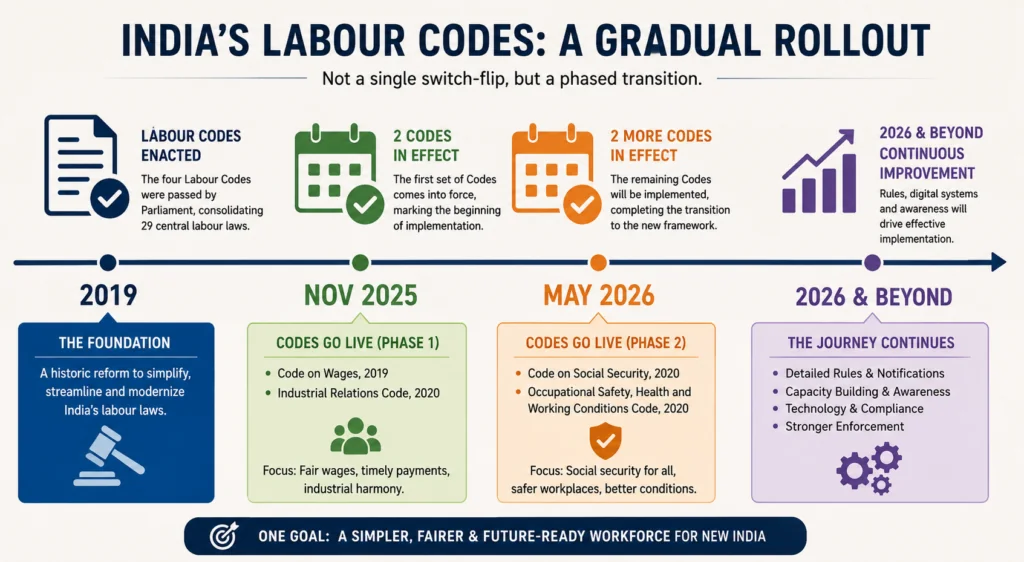
India passed four consolidated labour codes between 2019–2020 Wages, Industrial Relations, Social Security, and Occupational Safety, Health and Working Conditions replacing 29 older central laws. They were notified as effective from 21 November 2025, and the Ministry of Labour and Employment notified detailed central rules on 8–9 May 2026.
Because labour sits on the Concurrent List, individual states must also notify their own rules before the codes are fully enforceable in that state. As of mid-2026, only a handful of states including Gujarat, Haryana, Madhya Pradesh, Karnataka, and Maharashtra had notified final rules across all four codes; several larger industrial states were still working through drafts. The practical position for most employers through 2026: the codes are technically law, but day-to-day compliance in many states still runs largely on pre-code legislation and transitional provisions until state rules are finalised.
Two provisions worth knowing: fixed-term employment is now formally recognised, with gratuity eligibility dropping from five years to one for that category. Gig and platform workers are recognised for the first time under the Code on Social Security, with the aggregator-funded framework described above newer and less mature than the rest of the code.
Blue-collar contract labour continues to be governed separately by the older Contract Labour (Regulation and Abolition) Act, 1970, which applies once an establishment or contractor engages 20 or more workmen, until the OSH Code fully absorbs it state by state.
This reflects the publicly available legal status of contract jobs as of mid-2026. It’s a general explainer, not legal advice confirm current applicability with a labour law professional before making a hiring or employment decision, since state-level notification status keeps changing.
Permanent Roles vs Contract Jobs in India: Side-by-SidePermanent Employee vs Independent Contractor
Permanent Employee vs Independent Contractor
Key differences in employment relationship, benefits, taxation, income stability and career growth.
| Factor |
Permanent Employee
|
Independent Contractor
|
|---|---|---|
|
Relationship
|
Company controls how work is done | Company controls the outcome, not the method |
|
Job security
|
Ongoing, subject to termination process | Ends when the engagement ends |
|
Paid leave
|
Statutory leave applies | Not applicable |
|
EPF / ESI
|
Employer contributions apply | Not applicable |
|
Gratuity
|
After 5 years (1 year for fixed-term) | Not applicable |
|
Bonus
|
Statutory bonus may apply | Not applicable |
|
Notice / termination
|
Statutory notice and process | Governed by contract terms |
|
Tax
|
TDS deducted by employer | Contractor self-files |
|
Multiple clients
|
Generally exclusive | Core feature of genuine contracting |
|
Income stability
|
Predictable, fixed salary | Variable, tied to invoicing |
|
Career growth
|
Structured appraisals, promotions | Self-directed, rate-negotiated |
Permanent Employee vs Independent Contractor
Key differences in employment relationship, benefits, taxation, income stability and career growth.
| Factor |
Permanent Employee
|
Independent Contractor
|
|---|---|---|
|
Relationship
|
Company controls how work is done | Company controls the outcome, not the method |
|
Job security
|
Ongoing, subject to termination process | Ends when the engagement ends |
|
Paid leave
|
Statutory leave applies | Not applicable |
|
EPF / ESI
|
Employer contributions apply | Not applicable |
|
Gratuity
|
After 5 years (1 year for fixed-term) | Not applicable |
|
Bonus
|
Statutory bonus may apply | Not applicable |
|
Notice / termination
|
Statutory notice and process | Governed by contract terms |
|
Tax
|
TDS deducted by employer | Contractor self-files |
|
Multiple clients
|
Generally exclusive | Core feature of genuine contracting |
|
Income stability
|
Predictable, fixed salary | Variable, tied to invoicing |
|
Career growth
|
Structured appraisals, promotions | Self-directed, rate-negotiated |
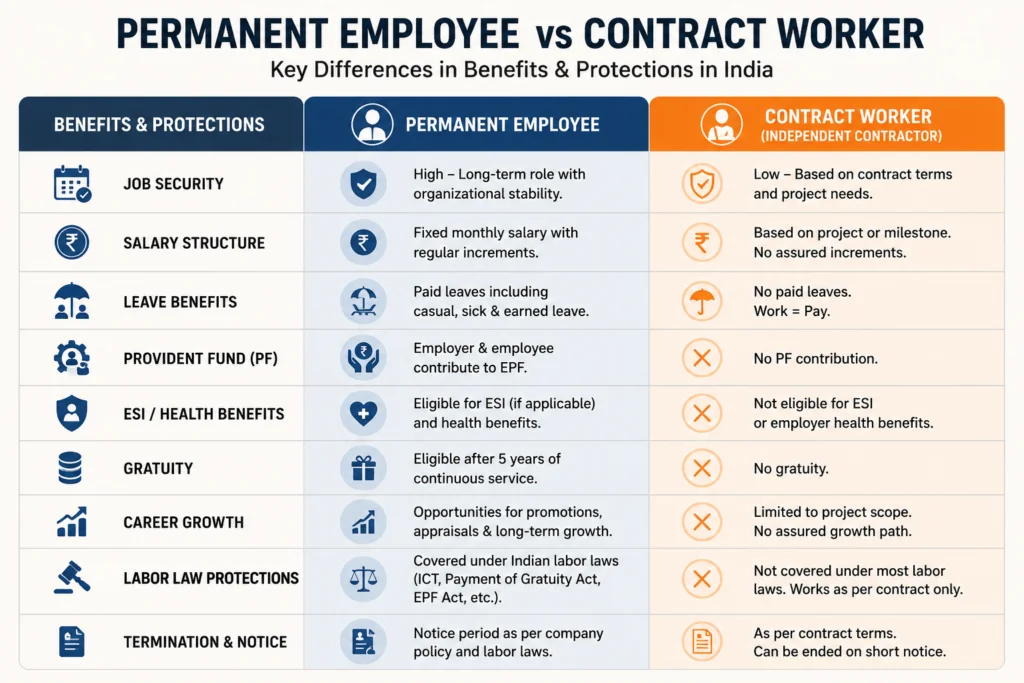
A fixed-term employee sits closer to the permanent-employee column on most rows under the current codes which is exactly why classification, not the label on the offer, decides the outcome for contract jobs in India. Anyone comparing two offers side by side should ask which column their actual day-to-day work will fall into, not which column the job title implies.
Why Tech Companies Are Leading the Shift Toward Contract Jobs
Technology is the clearest case study, because its work patterns favour flexible staffing more than most industries do. Product companies build in short cycles, and technical skills age faster than most professions a framework in high demand this year can be a maintenance skill in three. That makes permanent headcount a slower-moving asset than the problem it’s solving.
Indian staffing data backs this directionally: bodies have reported double-digit annual growth in formal IT flexi-staffing even while permanent tech hiring cooled, and 2026 industry reports describe firms deliberately keeping leaner core permanent teams supplemented by contract jobs in AI-adjacent, cybersecurity, and cloud roles, where demand for specific skills has outpaced permanently employed supply.
It’s worth resisting the cleaner but less accurate claim that “AI is replacing permanent jobs.” The data more directly supports a narrower read: companies are using contract jobs to bridge the gap while figuring out which AI-related skills they need permanently, and specialised AI and cybersecurity talent is commanding real premiums in both permanent roles and contract jobs alike which cuts against a simple replacement story.
The Worker Side: Why Indians Choose Contract Jobs Too
Contract jobs in India aren’t purely something companies impose on reluctant workers. A meaningful share of skilled professionals especially in tech, design, and consulting choose them deliberately, for higher project-based rates, international clients paid in stronger currencies, flexible schedules, freedom to pick projects, and faster exposure to different companies and stacks than one employer would offer.
What that trades away: no guaranteed continuity, income that varies month to month, no statutory paid leave, full personal responsibility for taxes and financial planning, no employer-funded health cover or retirement contribution by default, and gaps between contracts that have to be planned for rather than absorbed.
The Hidden Cost: Where the Risk Actually Moves
Strip away the framing on both sides and one pattern holds: permanent employment gives a worker predictable income and a statutory benefit floor, while contract jobs shift more of that uncertainty onto the individual. The contractor absorbs income volatility between projects, sources their own health insurance, builds retirement savings without an employer PF contribution, self-funds time off, and carries weaker negotiating leverage in any single engagement.
This isn’t automatically a bad trade highly skilled professionals in contract jobs within high-demand areas can price that risk into their rates and come out ahead, particularly with multiple concurrent clients. The imbalance shows up hardest for workers who are functionally full-time and exclusive but classified as contractors anyway: they carry contractor-level risk while getting employee-level control exerted over them, without an employee’s protections. That combination is exactly what Indian courts scrutinise most closely for misclassification.
Are Contract Jobs Actually Replacing Permanent Ones?
Government survey data doesn’t support a clean “permanent jobs are disappearing” story, even with contract jobs growing in visibility. The Periodic Labour Force Survey shows roughly 73% of India’s non-agricultural workforce was already informally employed without written contracts, paid leave, or social security well before the current contract-jobs conversation intensified, meaning a large share of Indian employment was never in the fully protected “permanent” category to begin with.
NITI Aayog’s projections put gig-economy workers at around 77 lakh (7.7 million) as of 2020-21, roughly 2.6% of the non-agricultural workforce, projected to reach about 2.35 crore (23.5 million) by 2029-30 a real increase, but still a minority slice of India’s workforce even at that scale. Separately, the Ministry of Labour and Employment has cited roughly 100 million contractual workers as of 2023, concentrated in manufacturing and IT services a snapshot of existing scale, not a precise year-over-year conversion rate away from permanent roles, since sources define “contractual” differently.
What the evidence more consistently supports: India is adding more forms of tracked non-permanent work fixed-term roles, flexi-staffing, gig and platform jobs on top of an employment base that was already substantially informal, rather than a wholesale conversion of existing permanent roles into contract jobs. In IT specifically, continued flexi-workforce growth during slower permanent-hiring periods is consistent with companies routing incremental growth through contract jobs rather than mass-converting existing employees. The evidence for a broad net decline in existing permanent roles is thinner and more sector-specific than the headline claim suggests.
Gig Worker, Freelancer, Contractor, Consultant: Not the Same Thing

- Gig / platform worker – earns through app-based or aggregator work, formally defined under the Code on Social Security, with aggregator-funded social security rather than traditional benefits.
- Freelancer – project-based, serves multiple clients directly, operates as a sole proprietor for tax purposes.
- Independent contractor / consultant – usually a longer or higher-value engagement, often with a formal agreement and milestones.
- Fixed-term employee – on payroll for a defined period, entitled to benefits comparable to permanent employees.
- Contract labour – the specific Contract Labour Act category, workers supplied by a licensed contractor, historically concentrated in blue-collar roles.
Getting these right matters, because legal protections, tax treatment, and realistic negotiating position differ across all of them – “I’m in contract jobs” doesn’t tell you nearly enough on its own, and lumping all contract jobs into one bucket is how misleading statistics get produced in the first place.
What Companies and Workers Each Gain and Risk
Companies gain from contract jobs: hiring speed, access to specialised skills, fixed-to-variable cost conversion, easier scaling. Companies risk with contract jobs: misclassification claims and back-payment liability, loss of institutional knowledge, over-dependence on individual contractors, weaker quality control.
Workers gain from contract jobs: higher project rates, schedule flexibility, faster exposure to varied projects, access to international clients. Workers risk with contract jobs: income instability, a smaller benefits floor, harder long-term financial planning, less cushion if a client relationship ends abruptly.
Is Contract Work the Future of Employment in India?
The honest answer sits between the two extremes the headline implies. India isn’t wholesale replacing permanent roles with contract jobs informal-employment data, gig-worker share, and flexi-staffing growth point to an economy formalising and diversifying its non-permanent arrangements more than hollowing out its permanent core. At the same time, the direction of travel in tech and several other sectors is real: companies are deliberately keeping permanent teams leaner and routing more incremental hiring through contract jobs, fixed-term roles, and flexible staffing, especially where a skill is narrow, temporary, or expensive to keep on payroll year-round.
What’s shifting fastest isn’t the total count of jobs so much as who carries the risk inside each one. Companies are retaining flexibility. Workers especially those without in-demand, portable skills are absorbing more of the income and benefit uncertainty a permanent role used to buffer. Whether that balance holds depends heavily on how completely the labour codes get enforced at state level over the next few years, and on how far the gig and platform social security framework matures beyond registration into real, funded benefits.
Frequently Asked Questions
Are contract jobs in India legal? Yes. Contract jobs, fixed-term employment, and independent contracting are all legal and widely used across Indian industries. What matters legally is whether the arrangement is genuine, reflecting real independence rather than disguised employment.
What’s the difference between “contract labour” and an “independent contractor”? Contract labour is a specific statutory category under the Contract Labour Act, involving workers supplied by a licensed contractor to a principal employer, typically for blue-collar or facility-support roles. An independent contractor is engaged directly through a commercial agreement and isn’t covered by that Act the two terms sound similar but aren’t interchangeable.
Do people in contract jobs get PF and ESI? It depends on classification. Genuine independent contractors generally don’t get employer PF or ESI contributions. Fixed-term employees on payroll are meant to get benefits comparable to permanent employees under the labour code framework. Contract labour under the Contract Labour Act may be entitled to certain benefits depending on the specific arrangement and state rules.
Can a company just call an employee a “contractor” to avoid paying benefits? Not safely. Indian courts look at the substance of the relationship control, integration, economic dependence, who supplies equipment not the label in the contract. If it functions like employment, it can be reclassified, exposing the company to back payment of statutory dues, penalties, and possible reinstatement claims.
Are India’s labour codes fully in force in 2026? The four codes took effect from 21 November 2025, and central rules were notified in May 2026, but states must separately notify their own rules before the framework is fully enforceable there. As of mid-2026, state-level implementation remained uneven, so practical compliance in many states still runs partly on transitional and pre-code provisions. Verify the current state-specific status before relying on this for a compliance decision.
SEO Metadata
Primary Keyword: contract jobs
Secondary Keywords: contract jobs in India, permanent jobs in India, contract employment India, fixed-term employment India
LSI Keywords: EPF ESI gratuity, Code on Social Security, gig and platform workers, Contract Labour Act, flexi-staffing India, sham contracting, misclassification India
Search Intent: Informational / investigative readers want to understand why the shift is happening and what it means for them, not to purchase or transact.
SEO Title (Rank Math): Contract Jobs in India: The Confusing 2026 Shift
Meta Description: Contract jobs in India are booming in 2026. See exactly what companies actually save, what workers risk, and whether permanent jobs are truly disappearing.
URL Slug: contract-jobs-india
H1: Contract Jobs in India: Why They’re Replacing Permanent Roles in 2026
Keyword density (verified programmatically): “contract jobs” 47 occurrences / 3,247 body words = 1.447% (target 1.4–1.6%, met)
Word count: 3,247 words (body only, excluding metadata) cornerstone/investigative length, appropriate for the depth this brief requires