
Learning how to buy first crypto can feel like standing at the edge of a pool, wondering if the water’s too cold. You’ve heard the stories. Someone made money. Someone lost money. Someone talks about wallets and order books like they’re basic math, and you’re left wondering where to even start.
Here’s the good news. Buying your first crypto today is far simpler than it was even three years ago. Exchanges have cleaned up their interfaces, added guided sign-ups, and built in security checks that protect you from your own mistakes. You don’t need to understand blockchain code or cryptography. You just need a clear path to follow.
By the end of this guide, you’ll know how to choose the right exchange, create a secure account, deposit money, place your first order, and avoid the mistakes that trip up almost every beginner.
A quick note before you begin: Buying, holding, and selling crypto is legal in India. What it is not, is legal tender. That means you can’t use it to pay rent, salaries, or bills, and it isn’t regulated the way stocks or mutual funds are. Treat it as a high-risk asset class, not a currency, and you’ll approach it with the right mindset from day one.
What You’ll Learn
- How to choose a beginner-friendly crypto exchange for beginners
- How to create and verify your account
- How to secure your account with 2FA and recovery phrases
- How to deposit money using bank transfer, card, or UPI
- How to buy your first crypto coin step by step
- How order books actually work
- Where to store your crypto safely
- The most common beginner mistakes to avoid
Step 1: Choose a Beginner-Friendly Crypto Exchange
A crypto exchange is a platform where you buy or sell cryptocurrency using regular currency, similar to how a foreign exchange counter trades your rupees for dollars. You open an account, fund it, and place a request to buy the coin you want.
For your first-ever purchase, go for a regulated platform that follows financial laws, keeps proper records, and isn’t going to disappear with your money. This matters more than fancy features when you’re buying your first coin.
For Indian users, it’s best to stick with exchanges registered with India’s Financial Intelligence Unit (FIU-IND), since these follow local KYC and anti-money laundering rules. Trusted options include:
- CoinDCX – built specifically for the Indian market with INR and UPI support
- WazirX – one of India’s earliest and most recognized exchanges
- ZebPay – long-running Indian platform with a simple beginner interface
- CoinSwitch – beginner-friendly app with a straightforward buying flow
- Mudrex – Indian exchange with curated coin baskets for newer investors
Foreign exchanges like Binance or KuCoin are not FIU-registered and come with added compliance risk for Indian traders. It’s safer to stick with platforms built and regulated for the Indian market.
Each of these Indian exchanges has its own strengths. There is no single “best” exchange for every situation. What matters is picking one that supports UPI, INR withdrawals, and a KYC process you’re comfortable completing.

Comparison Table: Crypto Exchanges for Beginners
| Exchange | Ease of Use | Supported Countries | Fees | Beginner Friendliness | Security Features |
|---|---|---|---|---|---|
| Binance | High | 180+ | Low to moderate | Good, with a learning curve | 2FA, withdrawal whitelist |
| Coinbase | Very high | 100+ | Moderate to high | Excellent | 2FA, insurance on custodial funds |
| CoinDCX | High | India-focused | Low | Excellent for Indian users | 2FA, KYC-based protection |
| Kraken | Moderate | 190+ | Low | Good | 2FA, proof-of-reserves audits |
| Bitget | Moderate | 100+ | Low to moderate | Fair | 2FA, asset protection fund |
Step 2: Create Your Account Securely
Signing up usually takes less than ten minutes. You will enter your email, create a password, and confirm your identity.
Crypto Exchange definition: The crypto exchange refers to an internet service where you can purchase, trade, and sell cryptos with fiat or other forms of digital currencies by being an intermediary for traders and buyers.
Typically, the KYC procedure is a requirement of every crypto exchange. Here, you will be asked to provide a governmental document as well as a selfie. The thing is that you have to undergo such verification since authorities demand from the exchanges to identify their users in order to reduce fraud and money laundering activities. This is very intrusive the first time around, but nowadays, it is required by all reputable exchanges.
It is better not to use any password that has been used for another account. Instead, pick a combination of letters, digits, and special characters and save it in a password manager.
Step 3: Secure Your Account
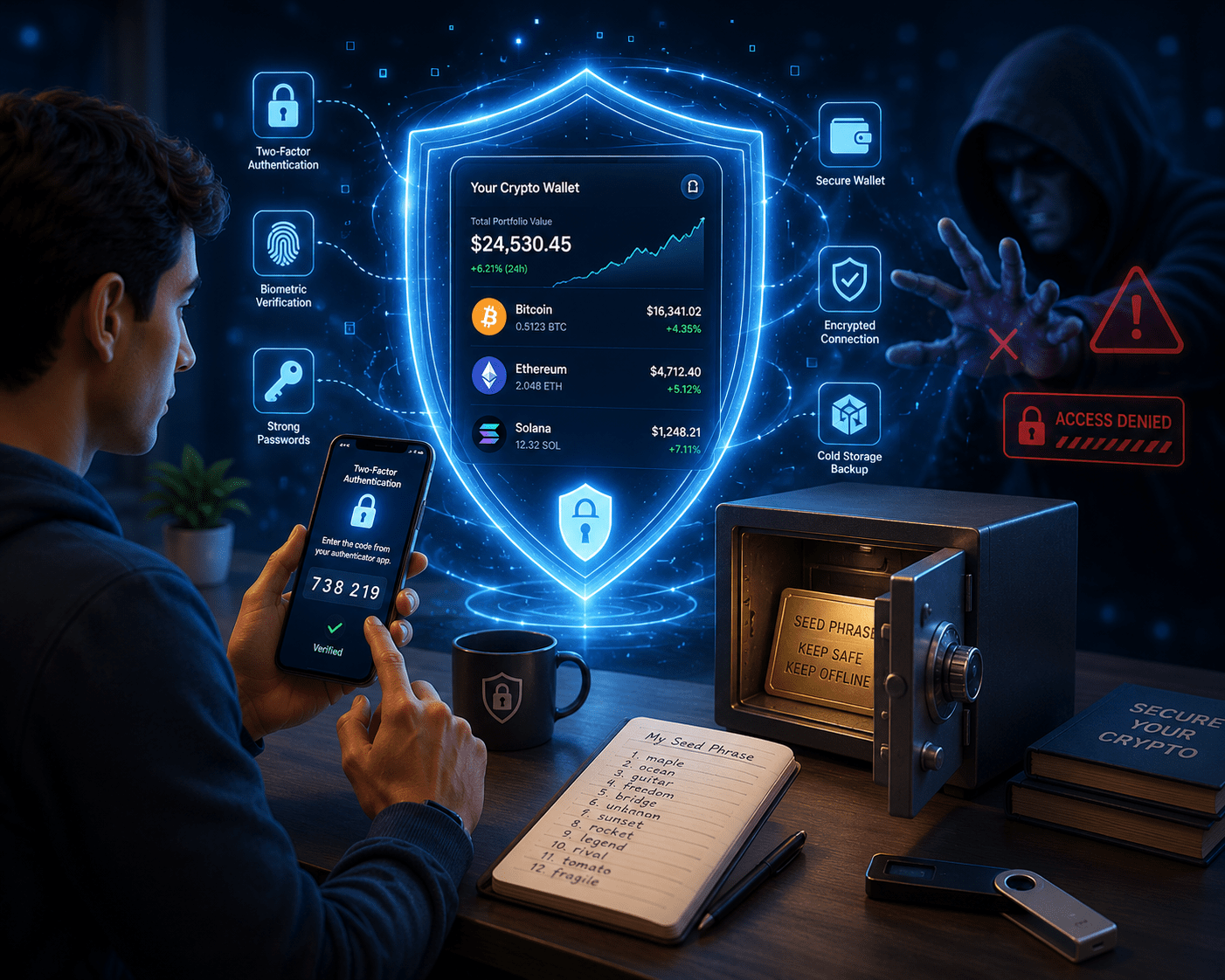
Before you deposit a single rupee, lock your account down. This step matters more than people expect, since crypto accounts are a common target for scammers.
Turn on Two-Factor Authentication (2FA) immediately.
Two-Factor Authentication definition: 2FA is a security step that requires a second form of verification, usually a code from an app on your phone, in addition to your password, making it much harder for someone else to access your account even if they know your password.
Use an authenticator app such as Google Authenticator or Authy instead of SMS codes where possible. SMS can be intercepted through SIM-swap attacks, while an authenticator app lives entirely on your device.
You’ll also receive a seed phrase, sometimes called a recovery phrase, if you set up a personal wallet.
Seed Phrase definition: A seed phrase is a set of 12 to 24 random words generated by your wallet that can restore full access to your crypto if you lose your device, making it the single most important piece of information to protect.
Practical security tips:
- Write your seed phrase on paper, never save it as a photo or a cloud note
- Store the paper somewhere fireproof and private
- Never share your seed phrase with anyone, including “support staff”
- Enable withdrawal whitelisting if your exchange offers it
Step 4: Deposit Money
Once your account is verified and secured, you can add funds. Most exchanges support a few common methods:
- Bank transfer – usually the cheapest option, though it can take one to two business days
- Debit card – instant, but often carries a higher fee
- Credit card – instant, though some banks block crypto purchases on credit cards
- UPI – fast and widely available on Indian exchanges like CoinDCX and CoinSwitch
For a first deposit, bank transfer or UPI is usually the safest and most cost-effective choice. Cards are convenient, but the fees add up if you plan to buy regularly.
Some beginners turn to P2P (peer-to-peer) trading to move money in and out of crypto, especially when bank transfers feel slow. Be careful here. P2P deals happen directly between two people, so there’s no built-in protection against fake payment screenshots, reversed transfers, or a buyer who simply disappears after you release the coins. If you’re new, stick to your exchange’s direct INR deposit options instead of P2P until you understand how escrow protection works.
Step 5: Buy Your First Crypto Coin
Now for the part you’ve been waiting for. Here’s what buying first crypto actually looks like on screen.
- Search for the coin you want, such as Bitcoin or Ethereum, using the search bar on the trading page
- Enter the amount you want to spend, in your local currency or in the coin itself
- Choose your order type: market or limit
- Review the order summary, including fees
- Confirm the purchase
Market Order definition: A market order buys or sells a cryptocurrency immediately at the best available current price, prioritizing speed over getting an exact price.
Limit Order definition: A limit order lets you set a specific price you’re willing to pay, and the trade only executes once the market reaches that price, prioritizing price control over speed.
For your very first purchase, a market order is usually easier. You’ll get the coin right away, and the price difference on a small first buy is typically minor.

Understanding the Order Book
The word “order book” sounds technical, but the idea is simple.
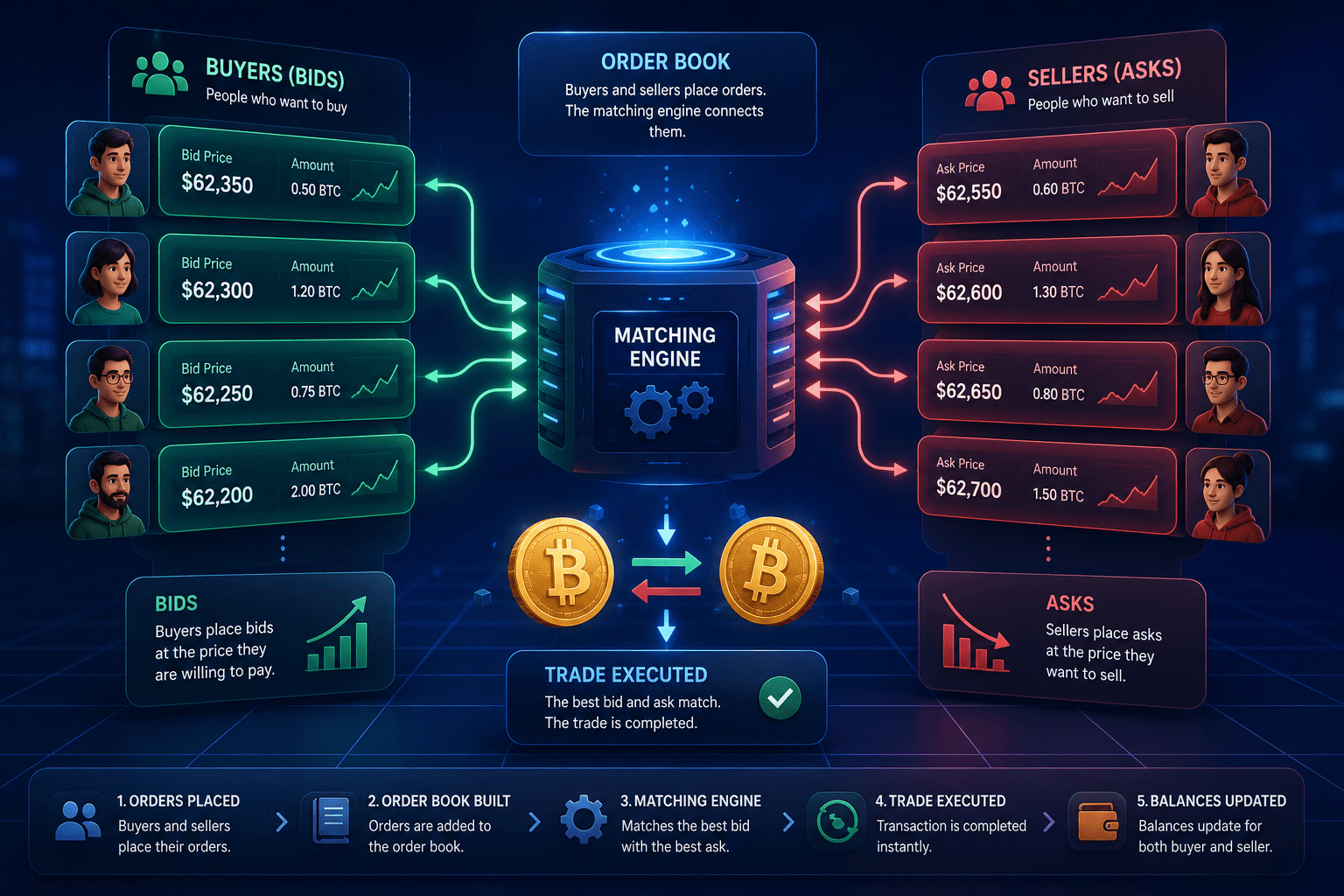
Order Book definition: An order book is a live list of everyone who wants to buy and everyone who wants to sell a given cryptocurrency, matched together based on the prices they’re willing to accept.
Think of it like selling a used phone online. You list your phone at a price you want. Other buyers list what they’re willing to pay. When a buyer’s offer matches your asking price, the sale happens. On an exchange, “bids” are buyer offers and “asks” are seller offers. The order book just tracks all of these at once, for thousands of buyers and sellers, updating in real time.
Where Should You Store Your Crypto?
Once you own crypto, you have three main storage options.
Exchange wallets keep your coins on the platform where you bought them. This is convenient for beginners and fine for small amounts you plan to trade or sell soon.
Crypto Wallet definition: A crypto wallet is software or hardware that stores the private keys needed to access and manage your cryptocurrency, working like a digital keychain rather than a physical container for coins.
Hot wallets are connected to the internet, such as a mobile app wallet. They are convenient for regular use but slightly more exposed to online attacks.
Cold wallets are offline devices, like a USB-style hardware wallet. They are the safest option for holding larger amounts long term, since they are never connected to the internet during storage.
If you are only buying a small test amount to learn the process, keeping it on the exchange is reasonable. Once your holdings grow, moving funds to a hot or cold wallet gives you full control over your coins.
Common Beginner Mistakes
- Investing more than you can afford to lose – crypto prices swing hard, so only use money you will not need soon
- Buying because of hype – a coin trending on social media is not the same as a good investment
- Ignoring security basics – skipping 2FA or reusing passwords invites trouble
- Falling for scams – no legitimate support team will ever ask for your seed phrase
- Buying random meme coins first – start with established coins before exploring higher-risk assets
- Forgetting recovery phrases – losing this means losing access permanently, with no customer service fix
- Not researching projects – check what a coin actually does before buying it
- Panic selling – reacting to a single red day often locks in losses that would have recovered

Beginner Tips for Long-Term Success
- Begin with an amount that is easy for you to test with
- Invest consistently over time without market timing
- Don’t mind about the day-to-day price movements but your timeline
- Educate yourself from trusted sources before investing in more coins
- Diversify your portfolio instead of putting all in one coin
- Think in terms of years, not in days
Also Read: how-ai-based-paraphrasing-tools-help-you-in-writing
Understanding Crypto Taxes in India
Any profit you make from crypto is taxed at a flat 30%, plus a 4% cess, no matter how long you held it or how small the gain was. On top of that, a 1% TDS gets deducted automatically on many transactions. You can’t offset a crypto loss against a crypto gain, and losses can’t be carried forward to next year. This is one of the strictest tax treatments in the world for crypto, so factor it into your expectations before you start trading actively.
Frequently Asked Questions
How much crypto should a beginner buy?
Start with an amount you could lose without financial stress, even as little as ₹500 or $10. This lets you learn the process without real pressure.
Is buying Bitcoin safe?
Buying Bitcoin through a regulated exchange with 2FA enabled is generally safe. The main risks come from weak account security or unregulated platforms, not Bitcoin itself.
Which crypto exchange is best for beginners?
There is no single best option. Coinbase and CoinDCX are known for simple interfaces, while Binance and Kraken offer more coins and features once you are comfortable.
Can I lose all my money?
Yes, cryptocurrency prices can drop sharply, and coins can lose most of their value. Never invest money you cannot afford to lose completely.
Do I need a crypto wallet?
Not immediately. You can start on your exchange’s built-in wallet, then move to a personal hot or cold wallet as your holdings grow.
Is crypto legal?
Cryptocurrency is legal in most countries, including India, though regulations and tax treatment vary. Always check your local rules before investing.
What is the safest cryptocurrency?
Bitcoin and Ethereum are generally considered the most established and widely tested cryptocurrencies, though “safe” is relative in a market known for volatility.
Can I start with ₹500 or $10?
Yes, most exchanges allow very small first purchases, which makes it easy to learn the process before committing larger amounts.
What is the difference between a market order and a limit order?
A market order buys instantly at the current price, while a limit order waits until the market reaches a price you set yourself.
Do I need to understand blockchain to buy crypto?
No, you do not need deep technical knowledge to buy your first coin. Understanding the basics helps, but the exchange handles the technical work for you.
Conclusion
There is no need for worry because purchasing your very first cryptocurrency does not have to be difficult anymore. You just have to select a regulated exchange platform, keep your account secure using 2FA and by storing your recovery phrase safely, make an initial deposit via a reliable method, and take baby steps.
Safety should always trump convenience. It is always better to make a slow purchase that is done carefully than a hasty one. This should serve as the start of your learning journey rather than one huge gamble.
Check out more resources for beginner cryptos on Tekraze to help you along.