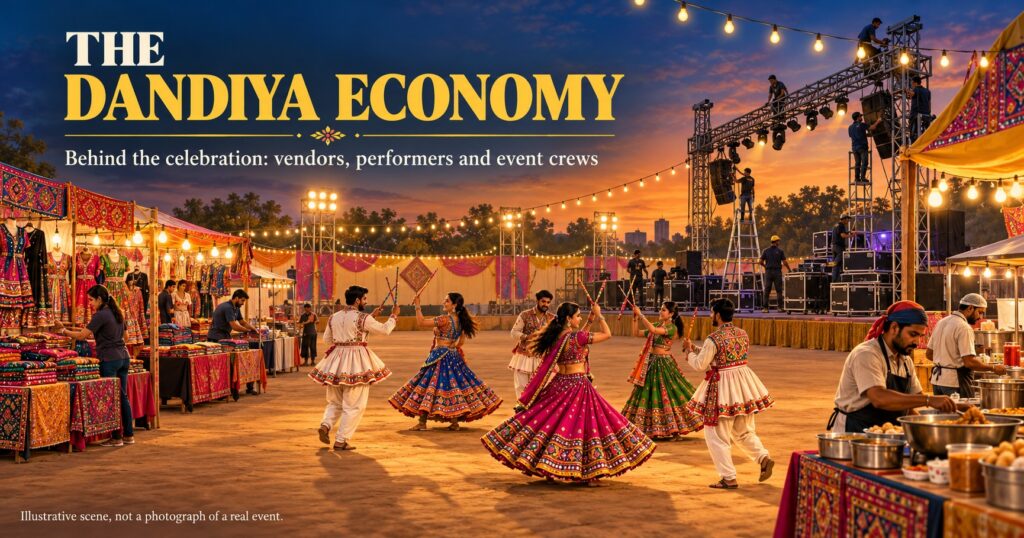
The Dandiya economy starts working long before the first dancer arrives, as this illustrative scene shows. It is not a reported observation.
Picture a ground at 6 p.m. A technician tests the speakers while a decorator adjusts a string of lights. Outside the gate, a vendor stacks dandiya sticks and a security supervisor briefs a team of temporary guards. A photographer checks her battery, and a rickshaw driver idles near the entrance, hoping the first rush of dancers arrives soon. None of these people will dance tonight, yet all of them are working because someone else will.
That is the starting point for a question worth asking. People now watch films on their phones, meet friends through apps and move between cities for work. So why do Garba and Dandiya nights still draw crowds, and who actually gains when they do? Navratri 2026 ran from 11 to 19 October, so the season has just ended. It is a good moment to look at the Dandiya economy with some care.
Following the money
Spending on a ticketed night spreads across many small businesses. The ticket pays for the venue, sound and lighting, a live band or DJ, decorators, security, staff and ticketing fees. Outside the gate, attendees spend on outfits, rentals, jewellery, dandiya sticks, food, transport and photographs. Some also paid for dance classes beforehand.
Also Read: Taxation on UPI in India: What Actually Changes in 2026 (MDR, GST, and the ₹2,000 Rule Explained)
Prices vary enormously by city and format. In Pune this season, entry at some events started between ₹49 and ₹249. A Delhi-NCR event at Okhla listed tickets from ₹799. In Ahmedabad in 2025, individual season passes at one major event cost ₹2,799 and group passes reached ₹18,999.
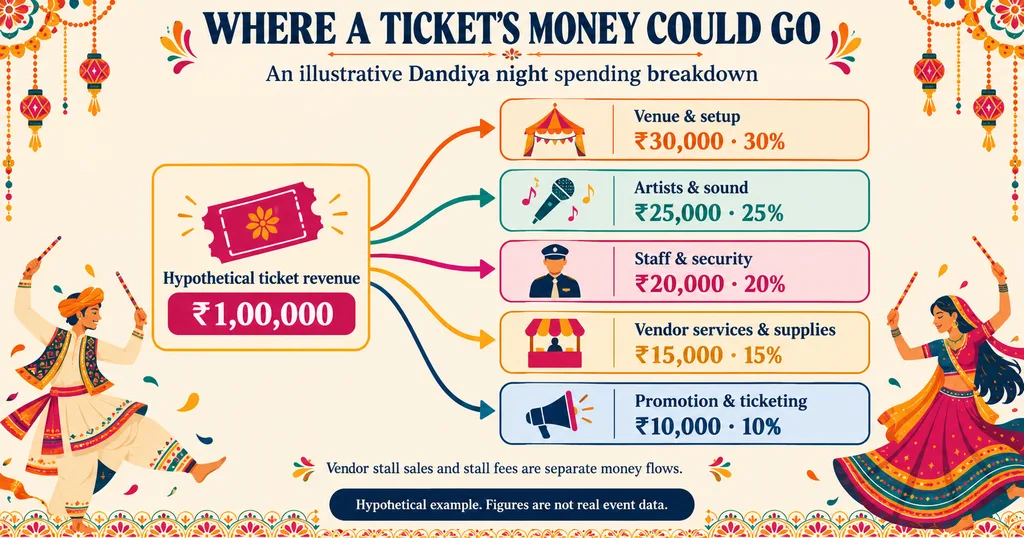
Four terms are easy to blur here, so a hypothetical example helps. Suppose an organiser sells 1,000 tickets at ₹500 each. That is ₹5 lakh of event revenue. After paying the venue, artists, equipment and staff, perhaps ₹60,000 remains. That is business profit, if the night goes well. Worker earnings are separate. A sound technician, a guard or a decorator is paid for the job whether or not the organiser profits. Broader economic impact adds the spending the event triggers elsewhere, such as the rickshaw ride or the borrowed outfit.
That last category needs caution. Some festival spending is not new money. A family that spends ₹800 on tickets may skip a restaurant meal that weekend. The activity moves from one business to another instead of being created. For that reason this article avoids a headline figure for the whole Garba or Dandiya economy. Estimates for India’s festive season do not describe these nights alone, and I did not find a reliable market-size figure for them.
Why the appeal survives
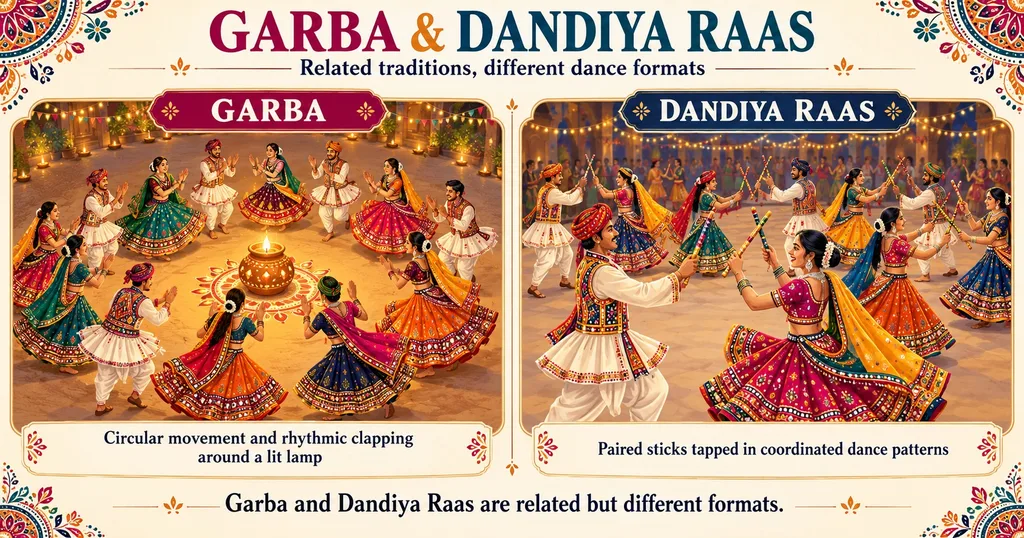
The recognition of Garba is a useful reference point, with one boundary to respect. In 2023 UNESCO inscribed “Garba of Gujarat” on its Representative List of the Intangible Cultural Heritage of Humanity. It describes the dance as ritualistic and devotional, performed during Navaratri in honour of feminine energy, or Shakti. The dancers move in a circle around a lit earthen pot or an image of the goddess. That inscription covers Garba. It should not be stretched to cover every Dandiya night, which is a related but different format. Dandiya Raas is danced with pairs of decorated sticks, while Garba is built around clapping and circular movement.
The same UNESCO entry says the practice involves musicians, craftspeople and others around the festivities, and notes that schools and universities teach costume design, sound and light design and related skills. Even in the official description, the dance and its supporting trades are linked.
People also attach different meanings to the same night. For one person it is devotion. For another it is a reunion with friends, a chance to dress up, nostalgia for a childhood neighbourhood, or a way to feel connected to a regional identity while living far from home. These motives can sit in the same circle. It would be a mistake to assume all young people share one reason or one budget.
The formats differ as well. A housing society event, a college night and a ticketed commercial show have different costs, audiences and expectations. They should not be treated as interchangeable.
The experience economy, and who can afford it
A commercial night sells more than a dance floor. Attendees are paying for a place to participate, meet friends and make memories, often with good sound, lighting and safety included. The product is the occasion.
That makes price a question of access. The gap between a ₹49 entry and an ₹18,999 group pass shows how differently the market serves different people. Tax rules may also shape pricing. One tax-advisory summary says admission to qualifying folk-dance events may be exempt from GST at ₹500 or below per person, with 18% GST above that. It suggests this explains why prices cluster at ₹399 and ₹499. That is a secondary source’s reading, and organisers should check the current rules.
Technology and the hype cycle
Reels, creator collaborations, digital ticketing and event discovery apps are now part of the season. Ticketing company Wowsly says that influencer content and online promotion help garba events reach large audiences. That is a vendor’s view, and views are not attendance.
Retail reports point the same way without proving it. In 2024, Bengaluru shopkeepers told a newspaper that rental demand for garba outfits had doubled since the previous year. They credited social media. One manager said his shop was renting nearly 200 sets a day, with basic outfits starting at ₹250 per day. These are shopkeeper accounts, not a measured study. Online visibility can plausibly lead to offline spending, but a viral video, a ticket sale and a person in the venue are three different measures.
Who benefits, and who carries the risk
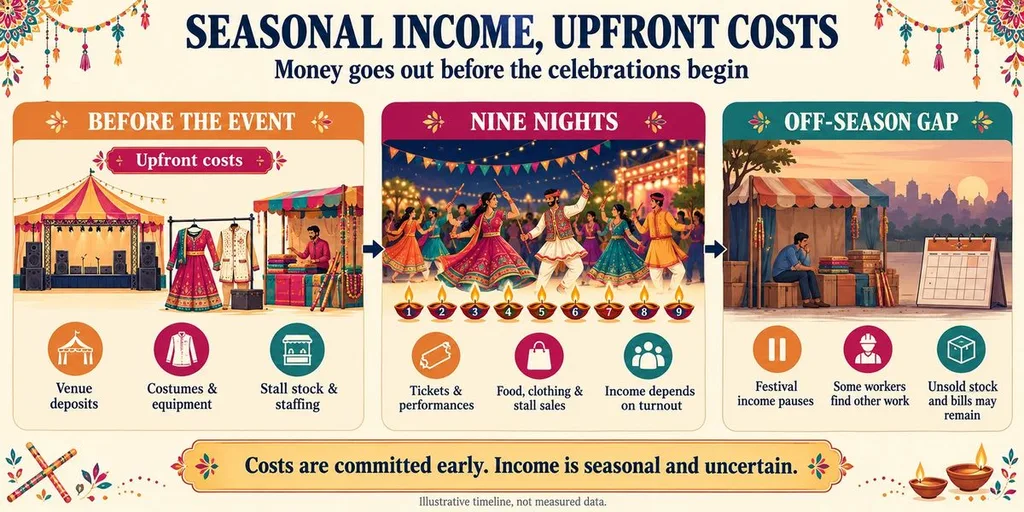
Not everyone in the chain is positioned the same way. A salaried employee at a lighting firm is paid regardless of ticket sales. A temporary vendor may buy stock in advance, hoping the weather holds and the crowd comes. Organisers often pay for venues, artists and equipment before they know how many tickets will sell. They may also depend on sponsors and compete with many other events on the same nights.
This season offered one example of that uncertainty. The Gujarat High Court asked an official to explain why permission was still pending for an organiser who had already sold passes. The application had been filed on 28 September for an event running from 11 to 20 October. One case does not describe the whole sector, but it shows that selling tickets and being cleared to hold the event are different things.
Income from the season is also temporary. A rental shop may do very well for nine nights and then wait a year. Seasonal earnings can be valuable, but they are not the same as steady work.
Culture and commercialisation
Commercial formats can bring in new audiences. They can also change what the night means. Gujarat’s garba scene has moved from neighbourhood gatherings with modest setups toward larger commercial events with higher entry fees and remixed music, including styles like techno garba, according to one trade-oriented report. Whether that counts as dilution or adaptation depends on who is asked.
The UNESCO documentation leans toward adaptation. The inscription decision says the element’s continuous renewal attests to its adaptability and creativity. A modern format is not automatically less authentic. It is a different format that may serve some of the same needs.
What this suggests
Culture and changing consumer behaviour do not have to compete. The Garba circle around a lit lamp and the Dandiya night with a DJ and a ticketing app can coexist, because people can come for different reasons and still end up in the same crowd. The economy around the nights works like a supporting structure. It depends on the celebration staying meaningful, and the celebration depends on enough people being able to reach it.
The more useful question for the next season is not whether tradition survives. It is who gets to participate, who earns a fair return for the work, and who is left carrying the risk when the night does not go as planned.
3. Source list
- UNESCO, Garba of Gujarat (inscription entry): https://ich.unesco.org/en/RL/garba-of-gujarat-01962?RL=01962
- UNESCO Committee decision 18.COM 8.B.32 (the search returned this on a non-standard UNESCO host, so confirm on ich.unesco.org before publishing): https://f5vip11.unesco.org/en/decisions/18.COM/8.B.32
- PIB announcement via Vikaspedia (inscription at 18th session, Kasane, 5-9 Dec 2023): https://www.vikaspedia.in/news/garba-of-gujarat-declared-as-intangible-cultural-heritage-by-unesco
- Business Today, Delhi-NCR Navratri 2026 events, dates and ticket starts: https://www.businesstoday.in/india/story/navratri-2026-garba-dandiya-events-in-delhi-ncr-check-dates-venues-timings-tickets-560835-2026-10-12
- Punekar News, Pune Navratri 2026 entry prices: https://www.punekarnews.in/?p=246808
- DeshGujarat, Ahmedabad Garba pass prices (Sept 2025): https://deshgujarat.com/2025/09/02/garba-pass-prices-soar-up-to-₹10k-in-ahmedabad-navratri-commercialization-in-spotlight/
- DeshGujarat, Gujarat HC and a pending Garba permission (13 Oct 2026): https://deshgujarat.com/2026/10/13/garba-passes-sold-yet-permission-pending-organiser-approaches-gujarat-hc/
- Deccan Herald, Bengaluru outfit rental demand (2024): https://www.deccanherald.com/amp/story/india%2Fkarnataka%2Fbengaluru%2Frental-demand-for-garba-dandiya-outfits-doubled-since-last-year-say-shopkeepers-3215939
- TaxGuru, GST and compliance for Navratri events (secondary analysis): https://taxguru.in/?p=1087712
- The CSR Journal, commercialisation of Gujarat garba: https://thecsrjournal.in/gujarat-navaratri-celebrations-economic-boom-garba
- Wowsly, Navratri trends (ticketing vendor, treat as an industry view): https://wowsly.com/whats-trending-this-navratri-in-india/
- Hindutone, Garba versus Dandiya Raas and 2026 dates: https://hindutone.com/festivals/navratri-2026-gujarat-garba-guide/