
If the office WhatsApp group keeps talking about “applying for the IPO” and “listing gain”, this guide is for you. An IPO is how a private company first offers its shares to the public and gets listed on a stock exchange. This article covers what an IPO is, why companies launch one, when it opens, how to apply with UPI or net banking, allotment, how to exit, how profit and loss work, and the terms on every form — price band, lot size, cut-off and GMP.
The rules below follow SEBI, exchange and Income Tax Department sources as of November 2026. Each issue still has its own dates and fine print in the Red Herring Prospectus (RHP). Read that document, and do not treat a WhatsApp forward or a proposal as the law.
What is an IPO?
IPO stands for Initial Public Offer. In SEBI’s words, it is when an unlisted company offers shares or convertible securities to the public for the first time — by issuing new shares, by existing holders selling some of their shares, or both. After that, the shares can list and trade on exchanges such as the NSE and the BSE. The definition is in SEBI’s FAQs on the ICDR Regulations (updated 15 May 2025).
Until the IPO, the shares usually sit with promoters, early investors and employees. After listing, anyone with a demat and trading account can buy or sell them at a live market price — unlike the fixed price band used during the IPO. An IPO is also different from an FPO (Further Public Offer), which is a later public issue by a company that is already listed.
Why do companies launch an IPO?
The offer document will say exactly where the money is meant to go. The usual reasons are:
- Fresh issue: the company creates new shares and receives the proceeds, often for expansion, debt repayment or working capital, as disclosed in the “objects of the issue”.
- Offer for sale (OFS) in the IPO: existing shareholders — often promoters or private-equity investors — sell part of their holding. That money goes to those sellers, not to the company. This is not the same as the separate OFS window that already-listed companies sometimes use on the exchange.
- A listed share and a public profile: listing can make later fund-raising, acquisitions, listed ESOPs and an eventual exit for early investors easier.
SEBI does not recommend any IPO, fix the price, or stand guarantee for your money. The issuer and the merchant bankers set the price band. Your job is to read the risks in the RHP and decide for yourself.
What you need before you apply
- A PAN, with the name and order of names matching your demat account.
- A demat account with NSDL or CDSL. Allotted IPO shares are credited only in demat form.
- A bank account with enough clear balance for the bid amount to be blocked. The money does not leave the account on the day you apply.
- For the UPI route: your own UPI ID, from a bank and a UPI app on SEBI’s lists for public issues. See the SCSB and recognised intermediary lists.
- A trading account if you want to sell after listing. A 3-in-1 account (bank + demat + trading) can also be used to apply.
Do not use a third-party UPI ID or a third-party bank account. Those applications are not considered valid for allotment.
When an IPO opens: the timeline
First the company files a Draft Red Herring Prospectus (DRHP) with SEBI (SME issues are filed with the exchange). After SEBI’s observations it files the Red Herring Prospectus (RHP) and announces the price band and dates. For an IPO, the price band must be announced at least two working days before opening. The gap between the floor and the cap cannot be less than 5% or more than 20%.
SEBI’s ICDR FAQs say a book-built public issue stays open for 3 to 7 working days (extendable by three days if the price band is revised). A fixed-price public issue can stay open for 3 to 10 working days. Many mainboard IPOs use a three-day window. Use the dates in that issue’s RHP and advertisements.
After the issue closes, the current rule is a T+3 working-day listing timeline. “T” is the closing date. SEBI shortened this from T+6 in its circular dated 9 August 2023. It became mandatory for public issues opening on or after 1 December 2023, and is carried in later ICDR master circulars, including the master circular dated 9 February 2026.
| Stage | When (indicative) | What happens |
|---|---|---|
| Issue opens | As per the RHP, after the price-band notice | You can bid during this window |
| Issue closes (T) | Last day of the issue | QIB and NII bidding typically ends around 4 pm; retail and reserved categories around 5 pm. The UPI mandate must usually be accepted by 5 pm. Your broker or bank may cut off earlier — do not wait till the last hour. |
| Allotment (T+1) | Next working day after close | The registrar finalises the basis of allotment; the stock exchange approves it |
| Unblock and demat credit (T+2) | Second working day after close | Money for allotted shares is debited; unused or unsuccessful amounts are unblocked; shares are credited to demat |
| Listing (T+3) | Third working day after close | Shares start trading. This is the first day you can sell on the market |
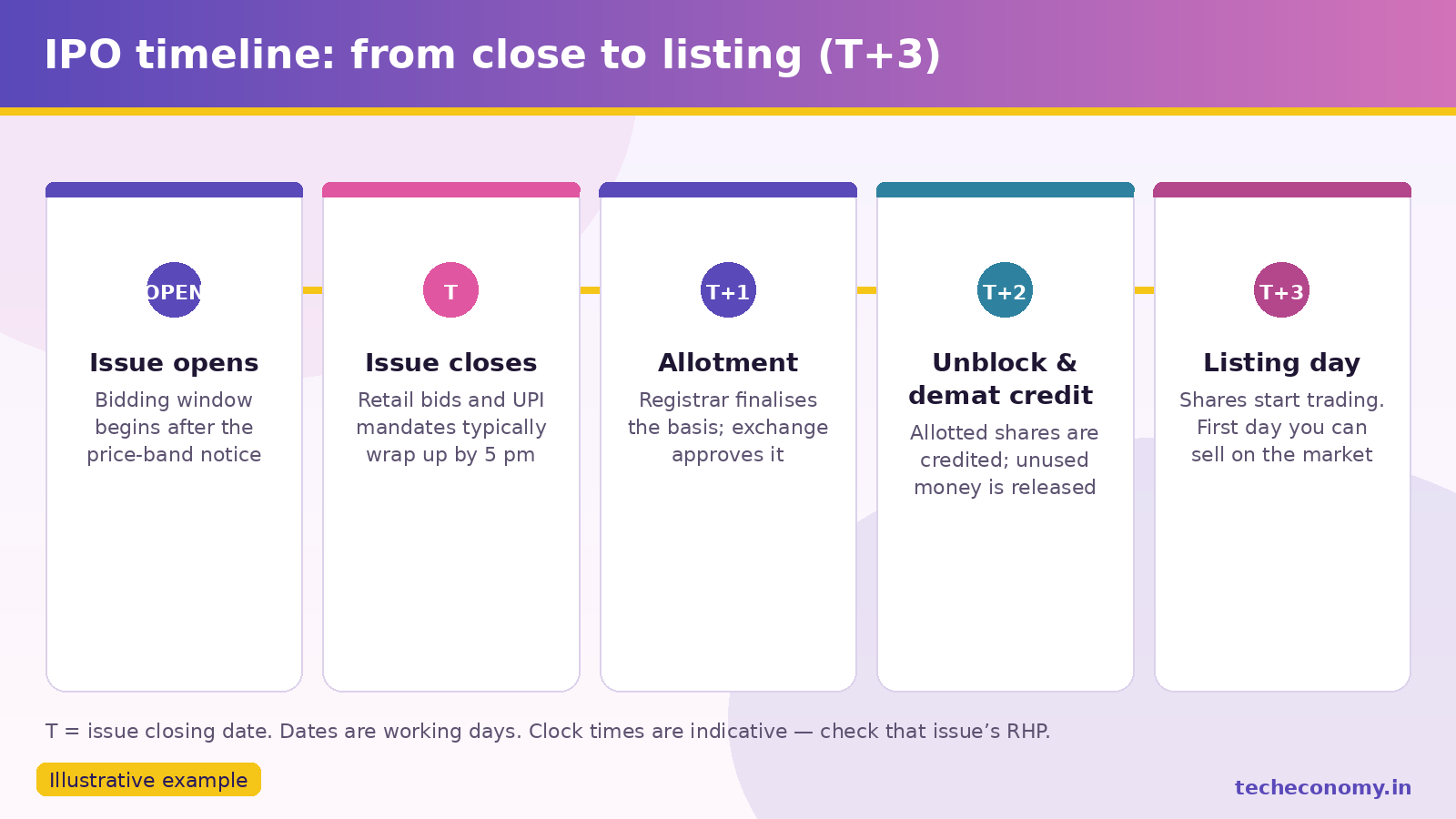
These clock times are the market-wide design, not a promise for every issue. If unblocking is delayed, contact your bank or UPI app, then the registrar and the merchant banker named on the offer document. You can also use SEBI SCORES.
How to apply for an IPO
In India you apply through ASBA — Application Supported by Blocked Amount. Your bank blocks the bid amount. It is debited only if you get allotment. The rest of your balance stays usable. ASBA is mandatory in public issues. SEBI explains it in its investor note on ASBA / UPI and in the ICDR FAQs.
Three common routes
- Broker, DP, RTA or syndicate, with a UPI mandate: the usual broker-app route. You enter the bid and your UPI ID, approve the mandate with your UPI PIN, and the amount is blocked. Individual investors can use UPI up to ₹5 lakh.
- Net banking or mobile ASBA with your bank: if your bank is a Self Certified Syndicate Bank (SCSB), you can apply on its IPO / ASBA page. This route is not capped by the ₹5 lakh UPI limit.
- A 3-in-1 account: if your bank, demat and trading account are in the same group, you can often bid there and the bank blocks the funds.
Step-by-step (typical UPI application)
- Confirm the issue is open. Note the price band, lot size, close date and whether it is mainboard or SME. Read at least the risk factors and objects of the issue in the RHP (also collected on SEBI’s public issues page).
- In your broker or intermediary app, choose the IPO, enter the number of lots and a bid price — or choose cut-off if you are a retail applicant.
- Enter your own UPI ID and submit. Check PAN, demat, amount and lots before you confirm.
- When the mandate arrives, verify the amount and the IPO details, then approve it with your UPI PIN. Until you approve it, the bid is not complete.
- Keep the bid number. You can confirm the upload on the NSE IPO bid verification page or the BSE application status page.
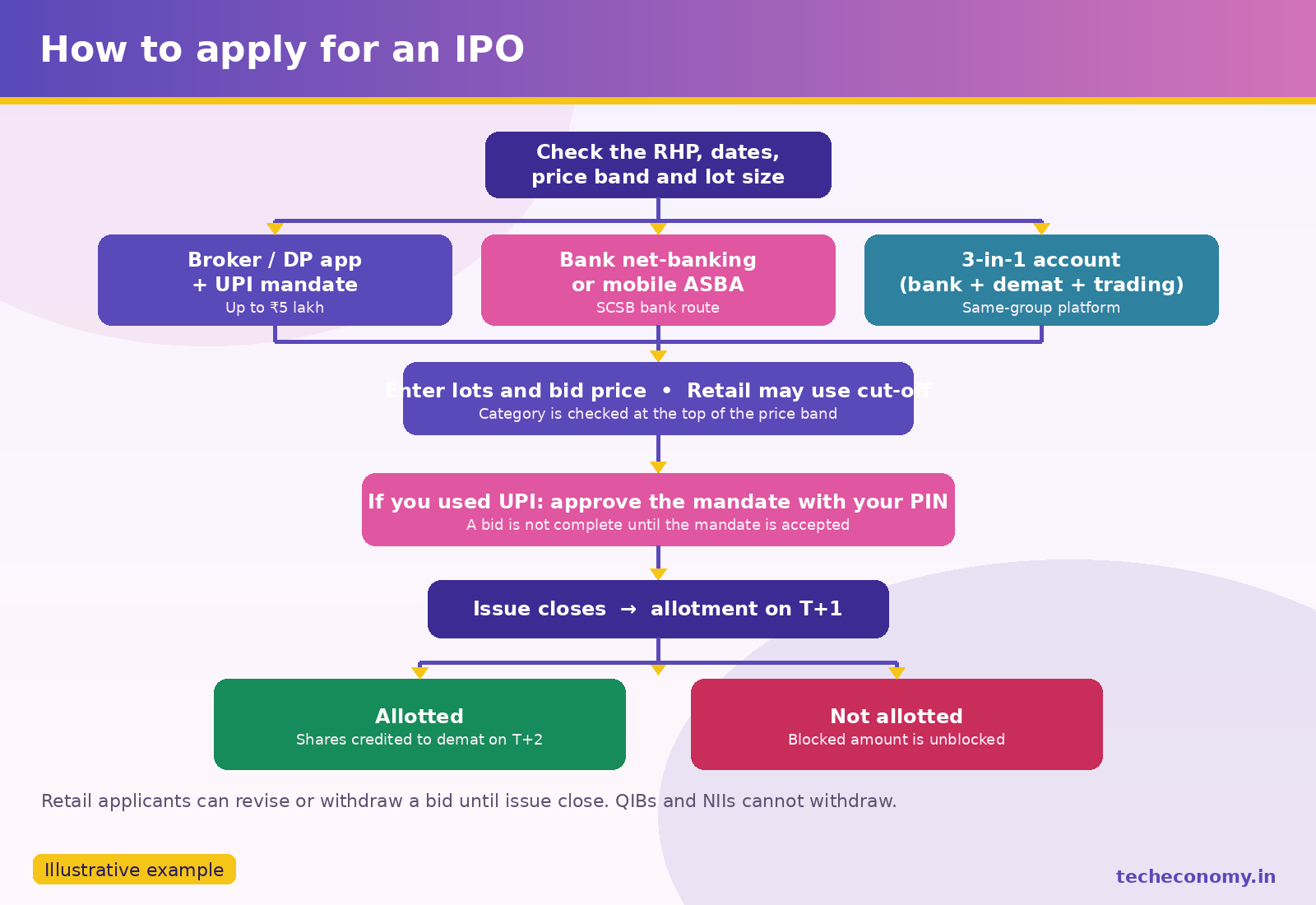
The ₹5 lakh UPI cap comes from NPCI and from SEBI’s circular dated 5 April 2022 (for issues opening on or after 1 May 2022). Retail still means a bid of not more than ₹2 lakh. If you bid more than ₹2 lakh and up to ₹5 lakh via UPI, you are an individual non-institutional investor (NII), not retail. SEBI’s May 2025 FAQs state this clearly.
Price band, lot size, bid and cut-off
The price band is the range, for example ₹95–₹100, within which you may bid. The final issue price is discovered from demand and will sit in that band. You bid in lots. If the lot size is 150 shares and the cap is ₹100, one lot costs ₹15,000 at the cap.
Retail applicants may tick cut-off, which means they accept whatever issue price is finally discovered. Money is still blocked at the top of the band; any extra is unblocked if the issue prices lower. Cut-off is only for retail (bids up to ₹2 lakh). QIBs and NIIs must quote a specific price — a bid below the final issue price can become invalid. Cut-off bids stay valid across the band.
Your category is checked at the upper end of the price band. If two lots would take you above ₹2 lakh at the cap, the second lot pushes you into NII, where allotment works differently.
Investor categories and the ₹2 lakh retail limit
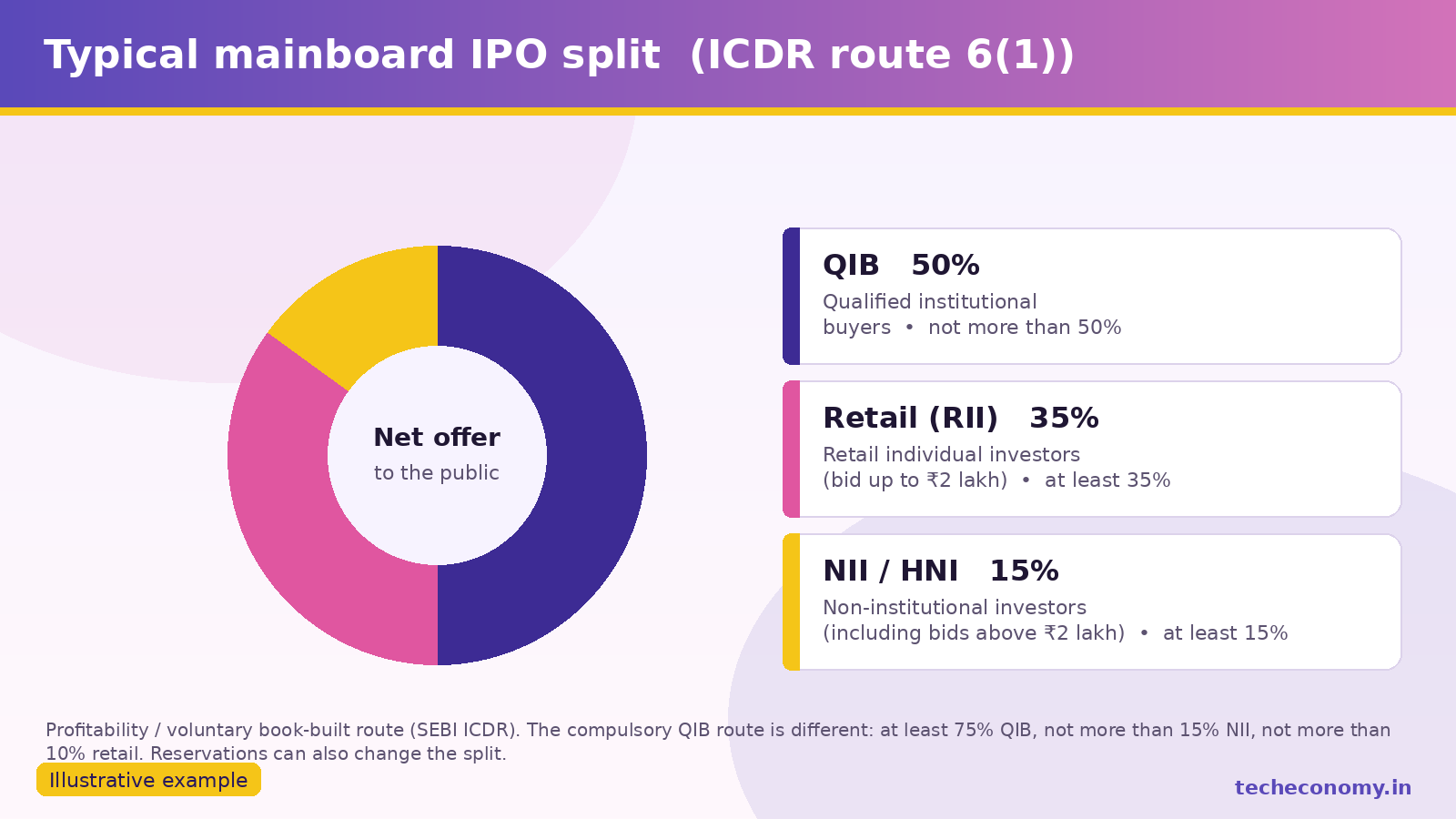
SEBI splits the public offer among categories. For a typical mainboard book-built IPO, the ICDR FAQs describe two patterns:
| Category | Who is in it | Share of the net offer (book-built) |
|---|---|---|
| Retail individual investor (RII) | An individual bidding for not more than ₹2 lakh | At least 35% on the profitability / voluntary book-building route; not more than 10% on the compulsory QIB route |
| Non-institutional investor (NII), often called HNI | Anyone who is neither retail nor a QIB, including an individual bidding above ₹2 lakh | At least 15% (profitability route) or not more than 15% (compulsory QIB route) |
| Qualified institutional buyer (QIB) | Mutual funds, FPIs, banks, insurers and other institutions listed in the ICDR Regulations | Not more than 50% (profitability route) or at least 75% (compulsory QIB route) |
Some issues also reserve a portion for employees or for shareholders of a listed promoter or listed subsidiary. Those caps, if any, are in the RHP. Anchor investors are large institutions usually allotted shares from the QIB portion one day before the issue opens. That is a demand signal, not a guarantee of a listing gain.
As a rule, use one application and one PAN for the main public portion. Multiple applications under the same PAN are typically rejected. If there is a separate employee or shareholder reservation, the RHP will say whether you may also bid in the net public offer.
How allotment works, and how to check status
Allotment is not first-come, first-served, and there is no discretion to favour one applicant. After close, the registrar aggregates valid bids in each category and finalises the basis of allotment with the designated stock exchange.
For retail applicants on the mainboard:
- If retail demand fits the shares reserved for that category, applicants can receive what they bid for, subject to the rules and lot size.
- If retail is oversubscribed, the registrar first tries to give at least one minimum lot to as many valid applicants as possible.
- If there are more valid retail applications than lots, a draw of lots (a lottery) decides who gets that one lot. Applying for more lots does not improve your chance of being picked in that draw. If you are selected and some shares are still left, extra lots may be allotted on a proportionate basis.
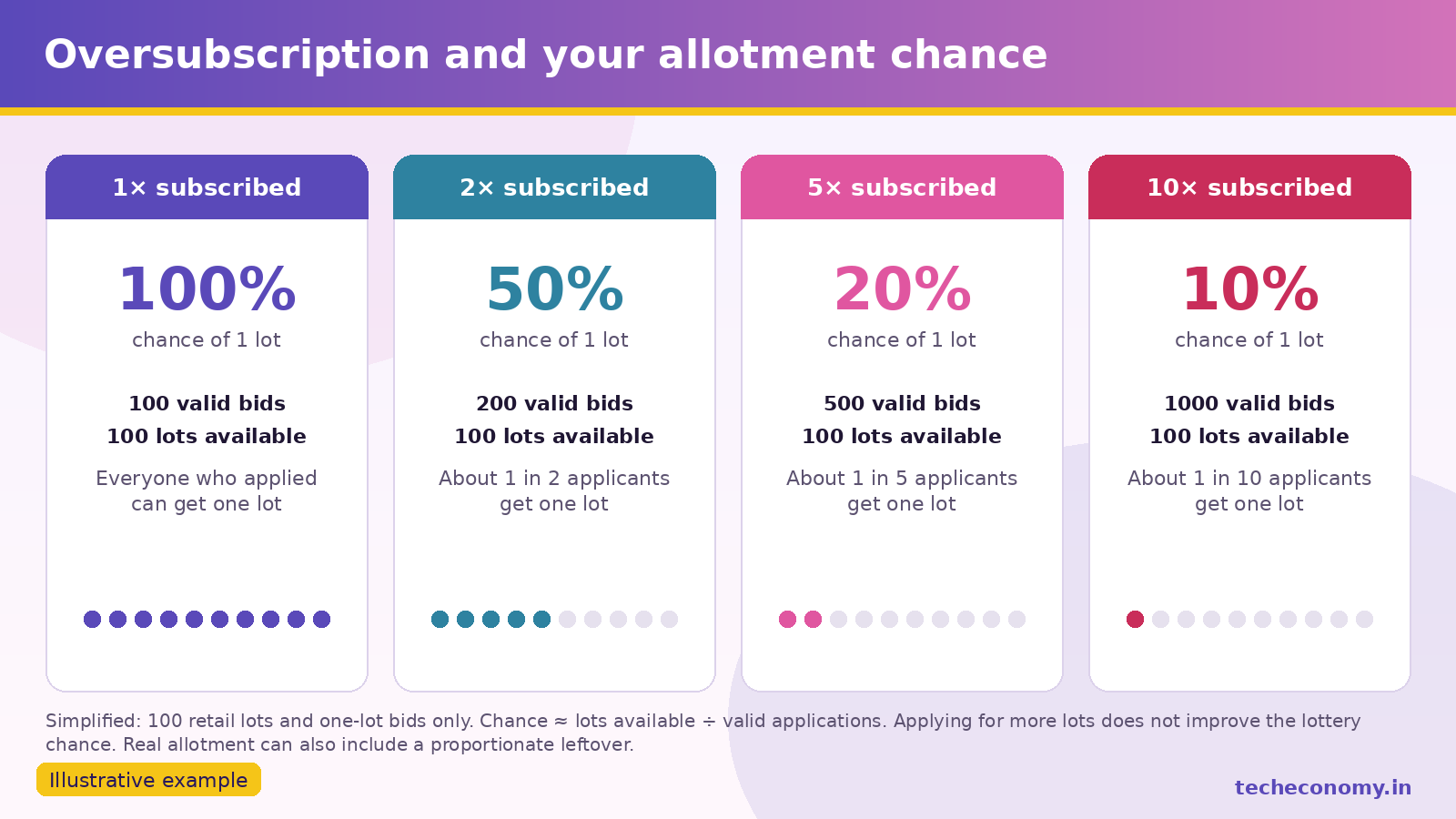
That is why a popular IPO can leave you with no shares even if you applied on day one and approved the mandate correctly. NIIs and QIBs follow their own proportionate rules in the ICDR Regulations and the RHP.
How to check allotment
- The registrar named in the RHP, using your PAN, application number or demat ID.
- The NSE Verify IPO Bid / Allotment page.
- The BSE Status of Issue Application page.
- SMS or email, if the registrar or your intermediary sends one.
Status usually appears after T+1. If your bid never showed on the exchange checker during the issue, contact your broker or bank at once — the application may not have been uploaded.
How to exit, cancel a bid, or what if you get no shares
Retail applicants can revise a bid or withdraw / cancel it until the issue closing date, through the same broker, bank or intermediary that took the bid. After a valid withdrawal, the blocked amount should be unblocked. SEBI’s ICDR FAQs say retail investors may change or cancel a bid until closure, and that QIBs and NIIs cannot withdraw.
If you applied via UPI and change the amount, you must approve a fresh mandate. Do not approve a new mandate after you have already cancelled the bid on the exchange — that can delay the release of funds.
If you are not allotted shares, the blocked amount is released (typically on T+2). You do not lose the application money, but it was not freely usable while it was blocked. There is no listing profit or loss on a bid that received no shares.
If shares are credited, you can sell on listing day or hold them. Selling needs a trading account linked to that demat. On the mainboard you can usually sell any number of shares, not only in IPO lots. The listing price can be much higher or much lower than the issue price, and it can move quickly. Exchanges may use a special pre-open session and price bands on listing day — check the exchange notice rather than assuming a number. Proceeds arrive on the usual cash-market settlement cycle, after brokerage, charges and securities transaction tax (STT).
How profit and loss happen
Your gain or loss is the difference between what you paid (the issue price, plus costs) and what you receive when you sell (the sale price, minus costs). If you get no allotment, there is no share profit or loss.
Here is a worked example. The figures are only for illustration — not a real IPO and not a forecast. Suppose the price band is ₹95–₹100 and the lot size is 150 shares. You apply for one lot at cut-off. Your bank blocks 150 × ₹100 = ₹15,000. The issue price is later set at ₹100, and you are allotted one lot. Your cost is ₹15,000, before later selling charges.
- Listing gain: the stock lists at ₹120 and you sell all 150 shares at that price. Gross gain = (₹120 − ₹100) × 150 = ₹3,000. Brokerage, STT and tax will reduce the net amount.
- Listing loss: the stock lists at ₹85 and you sell all 150 shares. Gross loss = (₹100 − ₹85) × 150 = ₹2,250, plus selling costs. A listing below the issue price is possible even when an issue was fully subscribed.
- Holding on: if you do not sell on listing day, later prices can move either way. Profit or loss is booked only when you sell.
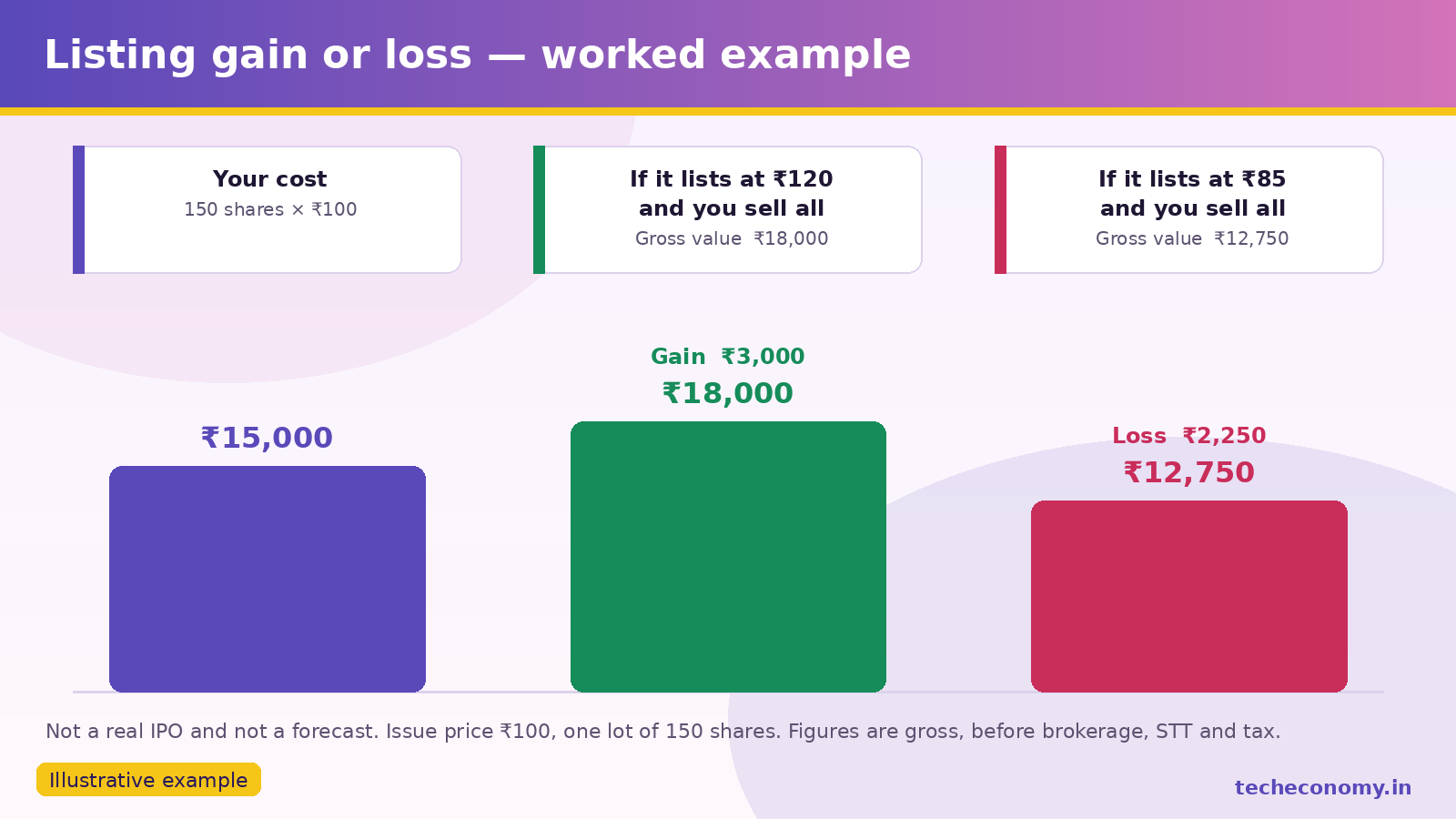
Oversubscription and a high unofficial “grey market” premium do not guarantee a listing gain.
Tax on listed IPO shares (STCG and LTCG)
Once the shares list, tax follows the rules for listed equity. There is no separate “IPO tax”. The rates below are the special rates in the Income-tax Act, 2025, as amended by the Finance Act, 2026. Budget 2026 did not change these equity rates from the July 2024 revision. Re-check the Income Tax Department’s official text before you file a return, because a later Finance Act can change the law.
| Holding period after you receive the shares | Type of gain or loss | Current special rate (STT-paid listed equity) |
|---|---|---|
| 12 months or less | Short-term capital gains (STCG) | 20% |
| More than 12 months | Long-term capital gains (LTCG) | 12.5% on gains above ₹1.25 lakh in a financial year |
The 12-month clock starts from the date you hold the shares, not from the day you applied. The ₹1.25 lakh LTCG exemption is a yearly threshold for the relevant listed-equity gains, not a per-IPO allowance. Cess and surcharge, if they apply, can increase the effective tax. STT is also charged when you sell listed equity on the exchange. A listing-day sale is almost always short-term.
In the example above, a ₹3,000 listing-day gain would be STCG at the 20% special rate, plus cess and any surcharge, after allowable costs such as brokerage. This is general information, not tax advice. The July 2024 change (STCG from 15% to 20%, LTCG from 10% to 12.5%) was explained in a Government of India press release.
IPO terminology you will see on the form
- Share price / last traded price: the market price on the exchange after listing. During the IPO there is no live market price — only the price band and, later, the issue price.
- Price band: the floor and cap between which bids are invited, for example ₹95–₹100.
- Issue price: the final price at which shares are allotted. In a book-built IPO this is discovered from bids and lies within the band. In a fixed-price issue it is stated upfront.
- Cut-off: a retail-only option meaning “I accept the final issue price.” Money is blocked at the cap of the band. Not available to QIBs and NIIs, and not available in SME IPOs under the rules from 1 July 2025.
- Lot size: the minimum bundle of shares you can bid for, and the multiple in which you must apply (1 lot, 2 lots, and so on).
- Face value: the nominal value of the share, often ₹10 or ₹1. It is not the issue price and not the market price.
- Issue size: the total size of the offer, usually in rupees and in number of shares, including the fresh issue and the offer for sale, if both exist.
- Fresh issue: new shares issued by the company; proceeds go to the company.
- OFS (in an IPO): existing shareholders selling part of their holding as part of the public offer; proceeds go to those sellers.
- Subscription / oversubscription: how many times the bids received cover the shares on offer, overall and by category. “Subscribed 40 times in retail” usually means a lottery, not a better guaranteed allotment.
- GMP (Grey Market Premium): unofficial, unregulated price talk from the informal grey market, often quoted as a premium over the cap. It is not published or supervised by SEBI, NSE or BSE. It can change quickly and can be wrong. Do not treat GMP as a promise of listing gain.
- Anchor investors: large institutions allotted shares just before the public issue opens, usually from the QIB portion.
- DRHP: Draft Red Herring Prospectus — the draft offer document filed for comments before the issue opens.
- RHP: Red Herring Prospectus — the offer document used to invite bids, with all key details except the final issue price in a book-built issue. Read this before you apply.
- Prospectus: the final offer document, including the final price and issue size.
- Registrar: the Registrar to the Issue, who processes applications, finalises allotment, credits shares and handles unblocking queries.
- Listing date: the first day the shares trade on the exchange. Under the current T+3 timeline this is the third working day after close, unless that issue’s documents say otherwise.
- SME IPO vs mainboard: a smaller issue listed on an exchange’s SME platform, under a different chapter of the ICDR Regulations. From 1 July 2025, SME IPOs opening under the new process no longer use the old “retail up to ₹2 lakh / cut-off / cancellation” model. The individual investor category has a higher minimum (at least two lots, and an application size above ₹2 lakh), cut-off bidding is not available, and downward modification or cancellation is not available. Liquidity after listing can also be lower. Read that issue’s RHP; do not copy mainboard habits into an SME IPO. See the BSE circular of 18 June 2025.
- ASBA and UPI mandate: the payment method — a block on your bank account, often authorised through a UPI request, rather than an upfront transfer to the company.
Risks you should not ignore
- You may get no shares. In a heavily oversubscribed retail portion, allotment is by draw of lots. Applying early or for more lots does not improve your chance in that lottery.
- Listing is not a guaranteed profit. The stock can list below the issue price. A high GMP, a strong subscription figure or a famous anchor list does not protect you from a loss.
- Your money is blocked for several days. Even if you are not allotted shares, that amount is not freely usable until it is unblocked.
- Business and document risk. An IPO is a stake in a business. Read the risk factors, related-party deals, litigation and use of proceeds in the RHP. SEBI’s observations are not a quality stamp.
- SME IPOs are a different product. Higher minimum ticket, different bidding rules, and often thinner trading.
- Scams and “guaranteed allotment” tips. Nobody can legally guarantee you shares in an oversubscribed IPO. Be careful of unofficial grey-market dealers, paid tip channels, and anyone asking you to apply from their account or to share your UPI PIN.
- Do not apply with money you need for rent, fees or an emergency. A listing loss, or even a delayed unblock, should not break your monthly budget.
FAQs
Do I need a demat account to apply?
Yes. IPO shares are allotted only in demat form. Without a demat account, you cannot apply.
Can I apply without UPI?
Yes. You can use net-banking or mobile ASBA with an SCSB, or a 3-in-1 account. UPI is one ASBA method, not the only one. It is the usual method when you apply through a broker for an amount up to ₹5 lakh.
What if I forget to approve the UPI mandate?
The bid is not valid. Approve the mandate well before 5 pm on the closing day. If you decline it by mistake, ask the intermediary to send a fresh request and approve that, still before close.
Can I apply in more than one IPO at the same time?
Yes, in different issues, if you have enough balance for each block. For the same IPO, do not put in multiple applications with the same PAN.
Is a fully subscribed or oversubscribed IPO a safe investment?
No. Subscription only tells you demand during bidding. It does not tell you what the share will do after listing, and it often means you may not get allotment.
Where do I look up forthcoming IPOs and offer documents?
Exchange websites list forthcoming issues. Offer documents are on the issuer’s site, the merchant banker’s site, the exchanges, and SEBI’s public issues filings page.
Who do I complain to if shares or unblocking are delayed?
Start with the registrar, your bank or UPI app, and the merchant banker named on the cover of the offer document. If that does not resolve it, use SEBI SCORES.
Official sources
- SEBI FAQs on the ICDR Regulations (updated 15 May 2025).
- SEBI circular on the T+3 listing timeline (9 August 2023); SEBI Master Circular for ICDR (9 February 2026).
- SEBI circular on the ₹5 lakh UPI limit (5 April 2022); SEBI investor page on ASBA / UPI.
- NSE: verify IPO bid and allotment; NSE ASBA procedures.
- BSE: status of issue application; BSE notice on the SME IPO bidding process (18 June 2025).
- Income-tax Act, 2025, as amended by the Finance Act, 2026; PIB release on the 2024 STCG / LTCG rate change.
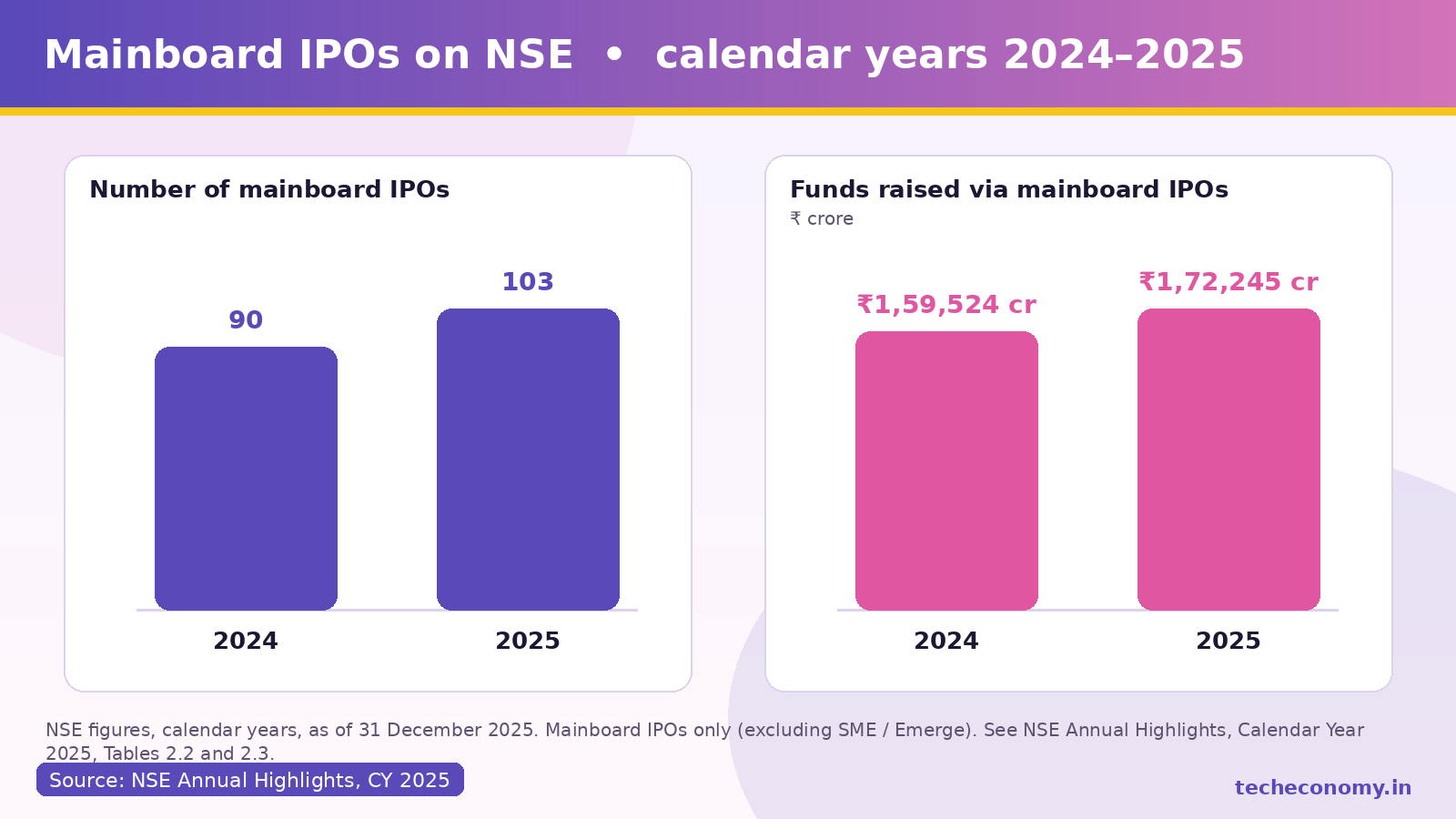
- NSE Annual Highlights, Calendar Year 2025 — mainboard IPO counts and funds raised (Tables 2.2 and 2.3, data as of 31 December 2025).
Disclaimer
Disclaimer: This article is for general information and education only. It reflects rules as of 11 November 2026 and is not investment advice, tax advice, or a recommendation to apply for any IPO. Share markets, including IPOs, carry a risk of loss, including listing at a price below the issue price. Timelines, category limits, SME rules and tax rates can change. Please verify the latest position on the official SEBI, NSE, BSE and Income Tax Department websites, read the Red Herring Prospectus of the specific issue, and consult a SEBI-registered adviser or a qualified tax professional before you invest.